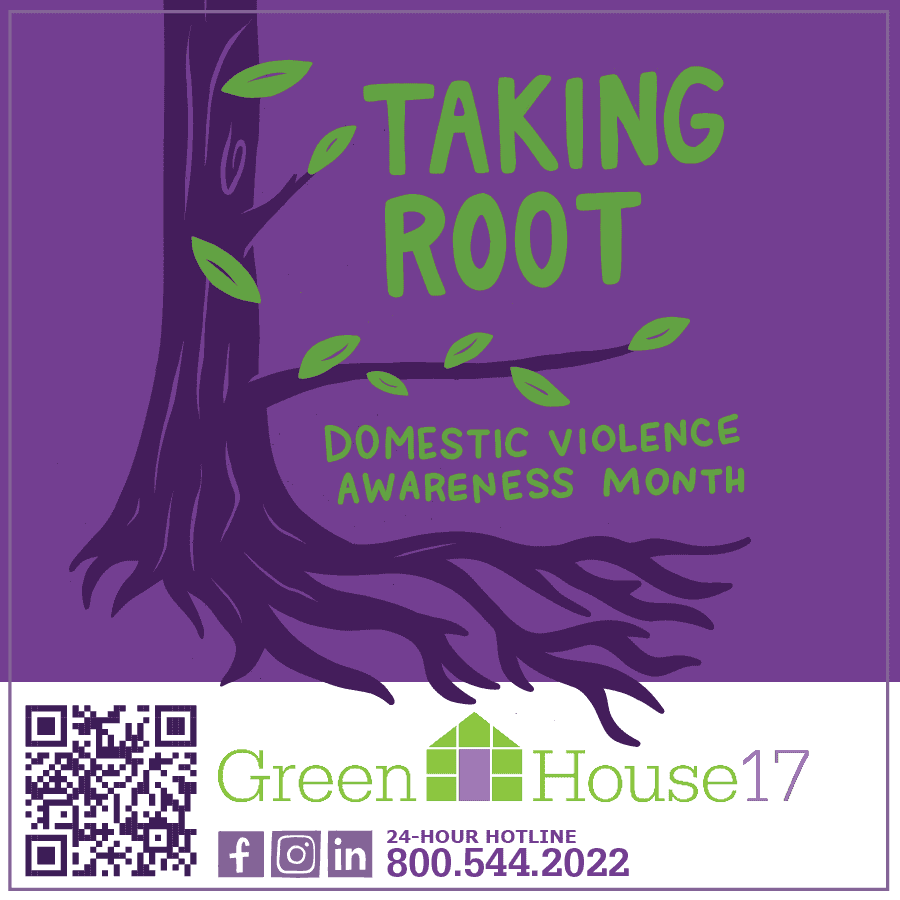
October is National Domestic Violence Awareness Month. Safety takes root in communities of faith that are informed about the dynamics of abuse and compassionate in their care for victims.
We have prepared the following resources for places of faith to begin discussions, make plans to participate, and show support during the month.
Spoken Announcements
CATHOLIC
October is National Domestic Violence Awareness Month. Scripture gives us the image of a tree rooted beside water and sustained through difficult seasons. Victims of domestic violence and their children also depend on networks of people and resources to flee abuse and begin to heal. Our parish can talk openly about domestic violence, learn to identify the signs, believe survivors, listen without judgment, and know what resources are available when someone asks for help. This month, consider how each of us can help support take root in our community. GreenHouse17 invites you to participate in Purple Thursday on October 15, a national day of wearing purple to identify yourself as somone who supports victims and survivors while calling for an end to the abuse. Learn more at GreenHouse17.org
CHRISTIAN
October is National Domestic Violence Awareness Month. Scripture reminds us that strong roots sustain life. In the same way trees are sustained through networks of roots, victims of domestic violence and their children depend on networks of people and resources to flee abuse and begin to heal. Our faith community can be part of that network. We can talk openly about domestic violence, learn to identify the signs, believe survivors, listen without judgment, and know what resources are available when someone asks for help. This month, consider how each of us can help support take root in our community. GreenHouse17 invites you to participate in Purple Thursday on October 15, a national day of wearing purple to identify yourself as somone who supports victims and survivors while calling for an end to the abuse. Learn more at GreenHouse17.org
HINDU
October is National Domestic Violence Awareness Month. Hindu tradition uses the sacred tree as an image of the deep connections that bind life together. Victims of domestic violence and their children depend on networks of people and resources to flee abuse and begin to heal. Our community can talk openly about domestic violence, learn to identify the signs, believe survivors, listen without judgment, and know what resources are available when someone asks for help. his month, consider how each of us can help support take root in our community. GreenHouse17 invites you to participate in Purple Thursday on October 15, a national day of wearing purple to identify yourself as somone who supports victims and survivors while calling for an end to the abuse. Learn more at GreenHouse17.org
JEWISH
October is National Domestic Violence Awareness Month. Jewish tradition reminds us of the strength found in deep roots, especially through difficult seasons. Victims of domestic violence and their children depend on networks of people and resources to flee abuse and begin to heal. Our community can talk openly about domestic violence, learn to identify the signs, believe survivors, listen without judgment, and know what resources are available when someone asks for help. This month, consider how each of us can help support take root in our community. GreenHouse17 invites you to participate in Purple Thursday on October 15, a national day of wearing purple to identify yourself as somone who supports victims and survivors while calling for an end to the abuse. Learn more at GreenHouse17.org
MUSLIM
October is National Domestic Violence Awareness Month. The Qur’an gives us the image of a tree with firm roots and branches reaching upward. Victims of domestic violence and their children depend on networks of people and resources to flee abuse and begin to heal. Our community can talk openly about domestic violence, learn to identify the signs, believe survivors, listen without judgment, and know what resources are available when someone asks for help. his month, consider how each of us can help support take root in our community. GreenHouse17 invites you to participate in Purple Thursday on October 15, a national day of wearing purple to identify yourself as somone who supports victims and survivors while calling for an end to the abuse. Learn more at GreenHouse17.org.
QUAKER
October is National Domestic Violence Awareness Month. Friends affirm the dignity and worth of every person and recognize the importance of community in sustaining one another. Victims of domestic violence and their children depend on networks of people and resources to flee abuse and begin to heal. Our Meeting can be part of that network by speaking openly about domestic violence, listening without judgment, respecting survivors’ choices, and knowing where help is available. This month, consider how each of us can help support take root in our community. GreenHouse17 invites you to participate in Purple Thursday on October 15, a national day of wearing purple to identify yourself as somone who supports victims and survivors while calling for an end to the abuse. Learn more at GreenHouse17.org
Bulletins & Service Program Messages
CATHOLIC
Scripture reminds us of a tree rooted beside water, sustained through seasons. During Domestic Violence Awareness Month, consider how our parish can help support take root. Victims of domestic violence depend on networks of people and resources to flee abuse and begin to heal. Listen, believe survivors, and know where help is available. Learn more and participate in happenings to show your support at GreenHouse17.org/dvam.
CHRISTIAN
Scripture reminds us that strong roots sustain life. During Domestic Violence Awareness Month, consider how our faith community can help support take root. Victims of domestic violence depend on networks of people and resources to flee abuse and begin to heal. Listen without judgment, believe survivors, and know where help is available locally. Learn more and participate in happenings to show your support at GreenHouse17.org/dvam.
HINDU
Hindu tradition uses the sacred tree to reflect life’s connections. During Domestic Violence Awareness Month, consider how our community can help support take root. Victims of domestic violence depend on networks of people and resources to flee abuse and begin to heal. Listen without judgment, support survivors, and know where help is available. Learn more and participate in happenings to show your support at GreenHouse17.org/dvam.
JEWISH
Jewish tradition reminds us that strong roots sustain us through difficult seasons. During Domestic Violence Awareness Month, consider how our community can help support take root. Victims of domestic violence depend on networks of people and resources to flee abuse and begin to heal. Listen, believe survivors, and know where help is available. Learn more and participate in happenings to show your support at GreenHouse17.org/dvam.
MUSLIM
The Qur’an reminds us of a tree with firm roots. During Domestic Violence Awareness Month, consider how our community can help support take root. Victims of domestic violence depend on networks of people and resources to flee abuse and begin to heal. Listen without judgment, believe survivors, and know where help is available. Learn more and participate in happenings to show your support at GreenHouse17.org/dvam.
QUAKER
Friends affirm the dignity and worth of every person and the importance of community. During Domestic Violence Awareness Month, consider how our Meeting can help support take root. Victims of domestic violence depend on networks of people and resources to flee abuse and begin to heal. Listen, respect survivors’ choices, and know available resources. Learn more and participate in happenings to show your support at GreenHouse17.org/dvam.
Bulletin Graphics & Posters
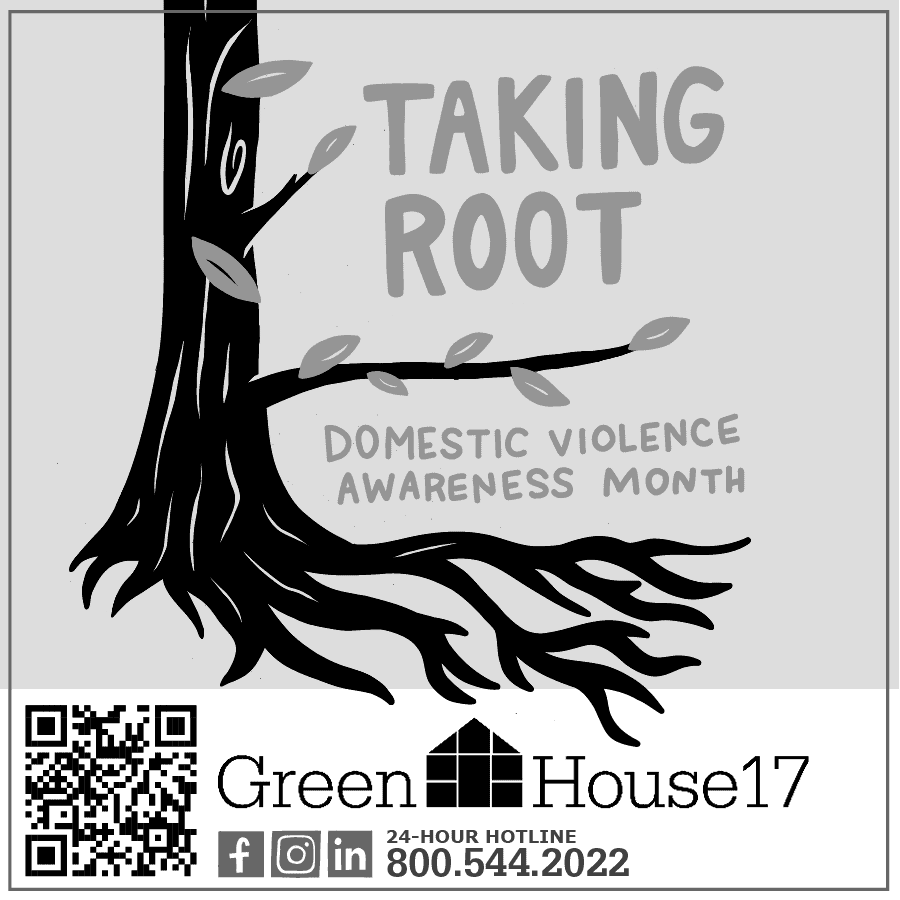
Bulletin Graphics
Posters to print and distribute or hang on bulletin boards:
Request a Faith Speaker
Christy Messick, Certified Domestic Violence Advocate, brings experience and understanding of our mission through her pastoral care and international ministry experience. She holds a Master of Divinity degree and speaks often to faith groups about how to support survivors within the context of their faith beliefs.
Complete this short form to connect with Christy about an upcoming speaking engagement:
A culture of support and understanding develops when faith groups talk about intimate partner abuse and develop strategies to respond.
Many survivors of intimate partner abuse identify their faith as a source of strength and comfort while healing from violence, while some say their faith made it more difficult to flee the abuse. Survivor-centered conversations about intimate partner relationships can be complicated by long-held beliefs in most faith traditions. We have prepared these resources to help guide your conversations.
Getting Started
What is meant by the term domestic violence?
Although the term domestic violence includes all family-related abuse, it most commonly is used to describe abuse by a spouse or dating partner. You might think of domestic violence as physical abuse, but it can take many forms. These include emotional, psychological, financial, and sexual abuse, and stalking.
How often does domestic violence happen?
Domestic violence affects millions of individuals across the United States, regardless of economic status, race, ethnicity, gender, sexual orientation, religion, or education. One in three women and one in four men will be a victim of intimate partner abuse at some point in their lifetimes. Each day an average of three women die at the hands of someone who claimed to love them.
What causes domestic violence?
Domestic violence is rooted in power and control. It’s not about anger management. The abuse is intentional and insidious. Abusers choose purposeful tactics to gain control and power, such as isolating their partner from supportive friends and family. As time progresses, the abuse begins to vary. Although slapping and hitting leave visible marks, most forms of domestic violence go unnoticed in public. Verbal, emotional, and financial abuse are common. What do you think are other common ways offenders use power and control over victims?
How can I support someone who is being harmed?
Survivors know their experience and story better than anyone, so one of the best things we can do is simply listen. If you are able to have a conversation with a survivor – who is comfortable with the conversation and has given you permission for the conversation – remember to ask if they feel safe. Say these words: “I believe you.” Don’t judge the decisions of survivors, even if they decide the safest decision is to stay for now. Help the survivor consider options and access resources. Share our 24-hour crisis hotline. It’s answered every hour of every day by Certified Domestic Violence Advocates: 800-544.2022.
Should I use the term “victim” or “survivor”?
Although similar in meaning, these words convey subtle differences. Many people who have experienced domestic violence prefer the term “survivor” because it speaks to strength and resiliency. Others prefer the term victim because it places blame on the abuser. If you’re unsure which term to use, ask the person you’re supporting which they prefer. If asking feels uncomfortable, use the term that makes the most sense to you during the conversation. The important thing is to begin a conversation.
Why so much purple?
Purple is the color designated for domestic violence awareness. Some believe the color was chosen because suffragists in the early 1900s wore purple, white and gold. Others connect meaning to the Purple Heart presented to those who exhibit courage and sacrifice during military service. More generally, the color purple symbolizes peace, courage, and honor.
Making Connections
What are some of the most common misconceptions about domestic violence?
Common misconceptions include that domestic violence only includes physical abuse; that heterosexual, cis-gender women are the only victims; and that domestic violence is a private, family matter. Why do you think these have become common misconceptions? Do you think the media portrayal of domestic violence in films, books, and news contributes to these misconceptions?
Why not just leave?
This question is most easily answered by considering other questions. What are the barriers to leaving? What power and control does the abuser have? Remember that survivors must think about their own physical safety and the safety of their children. Leaving can be the most dangerous time because the abuser is losing power and control, and victims often have little to no resources because the abuser also has controlled the household finances.
Have you ever used “victim-blaming” language?
What did she do to provoke him? He just wants attention. If it were that bad, why didn’t s/he file a police report? Well, I saw that coming a mile away. Maybe you’ve said or thought some of these things. You’ve surely heard others say them. We seldom assign blame to victims of other property crime, for example, so why do place responsibility on the victim for crimes of domestic violence? Some believe it’s a coping mechanism to reassure ourselves that it could never happen to us. What do you think about this idea? Discuss ways to identify victim-blaming language during conversations and challenge friends/family to reconsider their words.
What about the children?
Being exposed to or witnessing domestic violence can cause behavioral, developmental, and academic challenges for children.Consider that young children often blame themselves for the violence. As children get older, they may try to protect the abused parent and put themselves in harm. What are some other age-specific responses that children exposed to domestic violence may exhibit?
How does domestic violence intersect with other social issues?
It’s important to remember that domestic violence is an intersectional issue. Survivors often experience other “-isms,” including sexism, racism, classism, heteronormativism, and more. Collectively, these “–isms” play a devastating role in perpetuating gender-based violence and create multiple additional barriers to safety. Talk about how different oppressions and privileges affect survivors’ experiences. How can we better facilitate partnerships between domestic violence advocates other social justice movements?
How has technology changed domestic violence?
We live in a digital world, and social media has made so many things possible – both positive and negative. There are forms of abuse that never existed before, and technology-assisted abuse is becoming more pervasive. Youth are especially influenced and affected by social media and the digital world. How can we improve conversations with and education for children and teenagers about dating and domestic violence? What are some of the issues related to dating violence and the digital world that would be most pertinent to address with children in your life?
Considering Faith
How is faith related to the survivor experience?
Many survivors of domestic violence experience faith as a distinctive element of their identity and personal lives. While faith can be a source of strength and comfort, it is also complex and, when misused or misinterpreted, can complicate a victim’s situation.
Are there aspects of your specific faith tradition that could complicate a survivor’s experience?
Consider parts of your holy texts related to intimate relationships, gender roles, and marriage. How can you talk about these texts in a way that makes survivors feel safe in their own faith community?
How does your faith tradition support survivors?
Social support is vital in a survivor’s recovery. Are survivors in your religious community made to feel as though they are expected to choose between safety and their religious community or tradition? Are you familiar with KRS 209A, the revised Kentucky statute that requires professionals in a variety of sectors, including faith leaders, to provide resources and referrals for suspected victims of domestic violence?
How does your community of faith hold abusers accountable?
How do the clergy and lay leaders in your community hold perpetrators accountable when they are identified by survivors? Does your faith response further isolate the survivor? Religious leaders can condemn abusive behavior, while supporting survivors and referring abusers to appropriate community resources.
Does your faith community demonstrate commitment to ending domestic violence?
Do groups or missions in your faith community collaborate with local organizations working to support survivors? Consider reaching out to ask how your support could be of the most help. Do you priortize sharing local resources with your faith group and congregation? Including our 24-hour crisis hotline number in your weekly bulletin is an easy first step. That number is 800-544-2022.
Learn More
For a collection of denominational sermons and statements prepared by Safe Havens Interfaith Partnership Against Domestic Violence and Elder Abuse, visit this link.
To read stories that share personal accounts of surviving abuse, visit this collection of articles on our website.
To print our 24-hour crisis hotline poster to hang on bulletin boards and in washrooms, visit this link on our website.
We also offer a weekly video-based support group specific to spiritual care. Follow this link to request more information on our website.
For more information about specific services we offer and how to support someone who is being abused, please visit these pages on our website:
24-Hour Crisis Hotline
Safety Planning
Emergency Shelter
Safe Exchange & Visitation
Supporting Family & Friends
Financial Abuse
LBGTQIA Support
Healing After Abuse
Effects on Children