sunflower field with person in hat standing upBlog

New Survivor Stipend Match

A new one-time grant from Lexington-Fayette Urban County Government’s Office of Homelessness Prevention and Intervention (OHPI) will support nature-based healing and stability after surviving abuse.

Survivors living at the shelter experience the benefits of nature in many ways—from farm walks to nutritious meals. Adult survivors may choose to participate in a focused six-week project that provides a stipend for their contributions to the farm’s day-to-day operations.

“The stipend was amazing for me,” shares Eboni, a past stipend project participant. “I was able to save $200, get clothes for my son and me, fix my car, and even buy a washer and dryer for our new apartment.”

Funding from OHPI will provide a dollar-for-dollar match on the value of stipends earned by survivors. Matching funds can be applied to self-identified barriers to economic stability. Examples include expenses like car repairs, rental fees, job uniforms, medical care, and savings accounts.

“Nearly every person we serve has also suffered financial abuse,” shares Diane Fleet, associate director. “Survivors often face a long list of expenses that can delay and, too often, hinder progress made toward economic stability. Removing just a few of those barriers can make all the difference.”

“For future participants receiving more, it’ll just double their chances for success,” adds Eboni.

You can support survivors participating in the farm stipend program by attending a U-Pick Day on the farm in August or September! Click here to reserve your bucket for some flower picking fun.

Read the Summer 2025 Issue of Bloom

This is one article from our print newsletter. Follow the link above to read the full issue!

READ MORE
transitional housingBlog

National Fair Housing Month

April is National Fair Housing Month which celebrates the Fair Housing Act passing in April of 1968.

The actprohibited discrimination concerning the sale, rental, and financing of housing based on race, religion, national origin, sex, (and as amended) handicap and family status.” Read more about the history of fair housing on the US Department of Housing and Urban Development’s website here. 

Locally

Two big things have been happening in fair housing in the last few months.  

First, there was a proposed ordinance to prevent landlords from turning away low-income people who use federal housing vouchers or third-party payments for rental assistance.  

An advocate on our staff, Alyssa, attended one of the Social Services & Public Safety Committee of Lexington’s Urban County Council meetings in November. She said, “For many of our clients, short-term and long-term vouchers are the only way to get families on their feet to create safe homes for themselves and their children–sometimes for the first time ever.” 

In February, Lexington became the second city in Kentucky to ban source of income discrimination! Read more here.  

The other important law in fair housing is HB 5, or the ‘Safer Kentucky Act,’ which creates criminal penalties for street camping. Governor Andy Beshear vetoed the bill, but lawmakers overrode the veto and it goes into effect in July.

Here is part of the Homeless and Housing Coalition of Kentucky’s statement on the passage of HB 5 –  

“HB 5 will create criminal penalties carrying fines and jail time for people charged with “street camping.” HB 5 will allow cities and counties to create sanctioned encampments but provides no resources for actual shelter and housing.” 

Read the full statement here.

Stay up to date on local fair housing by following these local organizations. 
Homeless & Housing Coalition of Kentucky
KY Fair Housing
KY Tenants

Nationally

On April 22nd, the Supreme Court heard the case of Johnson v. Grants Pass. This case will decide if cities can pass laws like the ‘Safer Kentucky Act.’ The National Network to End Domestic Violence (NNEDV) participated in the Housing Not Handcuffs Rally during the hearing.  

NNEDV says, “We all deserve a safe place to live. And we can’t solve homelessness by punishing people for experiencing it. NNEDV calls on the Supreme Court to uphold the lower court’s decision that these punishments are cruel and unusual. And we call on policymakers to invest in proven strategies that help end abuse and homelessness, such as broad investments in affordable housing and targeted investments in survivor-specific housing programs.” 

A decision by the Supreme Court will be made by June 30th.  

Read more about the case here.

READ MORE
Blog

Shelter Life – Launching Phase

Walking into shelter for the first time can be a very scary experience.

Although every survivor’s journey after fleeing abuse is unique, our shelter services are designed around three phases of shelter life — Welcoming, Healing, and Launching. This is part three of a 3-part blog series that explores common activities during each phase.   

Launching 

When a survivor begins preparations to leave the shelter, they continue to work with their Healing Advocate and also choose another advocate to help during the Launching phase. 

Housing 

Although each survivor needs different types of housing support, most receive temporary rental and utility assistance. 

Some survivors transition to apartments in their home county or near supportive family and friends, while others move to apartments in the ZeroV Homes Lexington. Twelve of these units are scattered near downtown Lexington, with easy access to public transportation, and twelve cottage-style duplexes are nestled on the backside of the emergency shelter’s property.  

Breaking Down Fears 

A large part of the Launching phase is to work on emotional support. For a lot of survivors, this is the first time they’ve lived on their own in a long time.  

Advocates will work through fears and safety plan for survivors. If the survivor has children, our Youth Advocate will help safety plan with the kids. 

What’s Next? 

While a survivor is still at shelter, Launching Advocates will connect them with an Outreach Advocate in the community where they will be living. Staff members live and work in all 17 counties of our service area. 

Outreach Advocates continue supporting survivors after they transition out of shelter.  

Call us anytime.

24-HOUR HOTLINE 800.544.2022

READ MORE
map harrison nicholasBlog

Serving Harrison and Nicholas Counties

Survivors deserve to be supported in their home community.

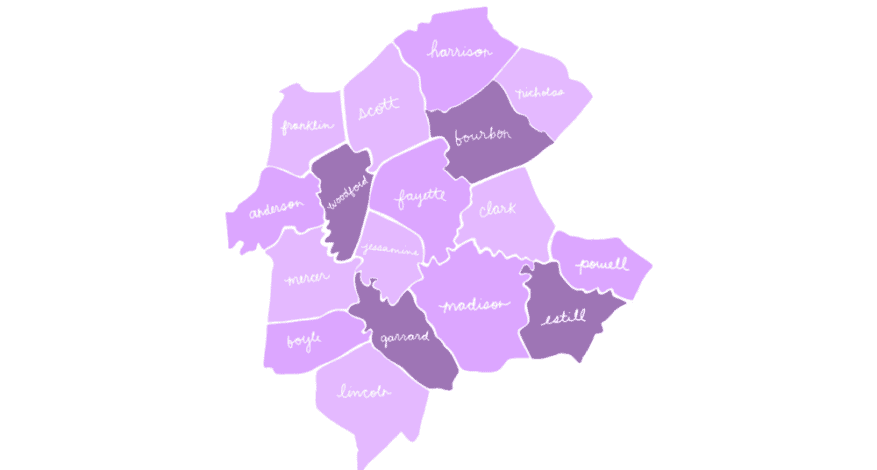
Although our emergency shelter is located in Lexington, staff of our organization live and work in all 17 counties of our service area – Anderson, Bourbon, Boyle, Clark, Estill, Fayette, Franklin, Garrard, Harrison, Jessamine, Lincoln, Madison, Mercer, Nicholas, Powell, Scott, and Woodford.   

Harrison & Nicholas Counties  

Anne Hodge is the advocate for survivors in Nicholas or Harrison Counties. Although each day is different, Anne dedicates much of her time to providing support for survivors before, during, and after family court hearings. 

What is a typical week for Anne?   
  • Anne provides legal advocacy during domestic violence court hearings on Mondays, Wednesdays, and Fridays.  
  • She also facilitates a weekly online support group about protective orders and legal basics, and connects survivors to other support groups offered by our organization. 
  • Another important activity is partnering with local organizations to make referrals for food, clothing, and other needs that survivors might experience. 

“People may need food or help with their electric bill or gas money. I refer them to agencies for financial assistance like Community Action or the Ministerial Association,” Anne explains. “Community partners are very valuable to our program and I keep in close contact with them.”

Legal Justice Matters  

Anne also coordinates the L-JUST project, a grant-funded legal justice effort to create an informed and supportive network of legal professionals across the central Kentucky region. One way Anne accomplishes this goal is through partnerships with attorneys who agree to provide no-fee services and representation for survivors navigating complex legal situations.

Get connected with an advocate in your county!

Call our 24/7 hotline at 800.544.2022

The L-JUST project is supported by subgrant number VAWA-2021-GreenHou-00029 subawarded by the state administering office for the Office on Violence Against Women, U.S. Department of Justice’s STOP Formula Grant Program. The opinions, findings, conclusions, and recommendations expressed in this publication are those of the author(s) and do not necessarily reflect the views of the state or the U.S. Department of Justice. 

READ MORE
welcome mat in front of doorBlog

Home Safe Home

Starting over after abuse takes time. 

Survivors often leave behind more than a home. Many begin again without furniture, clothing, and a vehicle. Sometimes the abuser has maintained power and control by not allowing a survivor to work or sabotaging their employment. Housing advocates help with these challenges.

“I have no family support and had nowhere to go,” shares a survivor who asked to remain anonymous. “I couldn’t afford daycare to work full-time and provide as a single mom.” 

While beginning to heal from the physical and emotional wounds of abuse, survivors meet with housing advocates to create an individualized housing plan. Early conversations imagine possibilities and identify barriers. 

Legal advocacy, credit repair, benefit applications, and budgeting assistance begin to chip away the obstacles. Partnering organizations provide job search, childcare, and other resources to help make the transition possible. Although each survivor needs different types of housing support, most receive temporary rental and utility assistance. 

Some survivors transition to apartments in their home county or near supportive family and friends, while others move to apartments in KCADV Homes Lexington. Twelve of these units are scattered near downtown Lexington, with easy access to public transportation, and twelve cottage-style duplexes are nestled on the backside of the emergency shelter’s property. 

Our housing team partners with dozens of organizations, companies, and landlords to support survivors during the transition to safe, affordable housing. Jubilee Jobs of Lexington offers job search services; Habitat for Humanity ReStore provides vouchers for furniture purchases; and Wildcat Moving, 2 Dudes Moving, and College HUNKS Moving offer services at no cost or reduced fees. 

“I always felt supported while in the program, and my abuser never knew where to find me. I can feel safe and my children can, too.” 

Read the summer issue of Bloom

This is one article from our print newsletter. Follow the link above to read the full issue!

READ MORE