Blog

Endow Kentucky Tax Credit Opens Soon!

The Endow Kentucky Tax Credit can support survivors and offers a great tax incentive.

Endow Kentucky Tax Credit season is quickly approaching! Tax credits totaling $1 million will become available on July 1. But these tax credits are often gone in the first week, so now is the time to start planning!  

Individuals and businesses can receive a credit on Kentucky state taxes of up to 20% of a gift to our endowed fund held at Blue Grass Community Foundation. The credit is in addition to your federal and state charitable tax deduction. 

Is there a minimum or maximum gift amount for the tax credit?  

There is no minimum gift size required to receive the tax credit. Unlike tax deductions, tax credits are subtracted from a donor’s tax bill, dollar for dollar. A gift of $5,000 can reduce what you owe in state taxes by $1,000. A gift of $50,000 can reduce your tax bill by $10,000. The maximum gift amount is $50,000.  

Not itemizing your charitable donations this year?  

You can likely still take advantage of the Endow Kentucky Tax Credit. This is a state tax credit, not a deduction. A tax credit reduces your Kentucky state tax liability dollar-for-dollar, regardless of your ability to itemize.   

Are donations of non-cash assets eligible for the tax credit? 

Yes, here is the list of non-cash assets that could be eligible:

  • stocks, 
  • mutual funds, 
  • tangible property, 
  • donations of life insurance, and 
  • donors 70 ½ and older can make a qualified charitable distribution from qualifying IRAs (QCDs can be made to any endowed funds other than donor advised funds).  
How do I make an endowment gift eligible for the credit? 
  1. The first step is to complete the Application for Preliminary Authorization.
  2. The completed form should be mailed or emailed to the Kentucky Department of Revenue in Frankfort. Addresses are included in the application, but if you’d rather just drop it off at the Blue Grass Community Foundation office, they’ll mail it for you.
  3. Next steps and additional resources, including contacts at the Blue Grass Community Foundation, are linked at the bottom of this page. 
How can I learn more about your endowment? 

Send a note to Corissa Phillips, Certified Fund Raising Executive on staff. She looks forward to sharing more about how our permanent endowment supports the mission in perpetuity–through times of crisis and opportunity. 

This post was written with information provided by the Blue Grass Community Foundation. We always encourage you to consult your accountant or professional advisor to learn about the personal impact of receiving your tax credit.

READ MORE
Blog

Let’s Talk About Septic Systems

We never expected to type these five words on our blog. Let’s talk about septic systems. 

Septic systems aren’t top of mind when you think about our mission. But the disposal of septic waste is critically important to any home or facility, especially an emergency shelter with 42 adult and child residents each night. 

Our large 19,326-square-foot shelter facility requires two septic systems.

Waste from the shelter is pumped into two tanks, each connected to a separate leach bed. These leach beds are formed by hundreds of feet of underground perforated pipe meandering through our front lawn. Liquid waste seeps through holes in the pipes to be naturally filtered by the soil.   

Something’s not right 

The standard lifecycle for a septic system is about 25 to 30 years. Our systems were built during the facility’s original construction 25 years ago.  

During the pandemic response, we noticed slow drainage from shelter sinks, showers, tubs, and toilets. The grass on the property’s front lawn felt a little mushy, even though it hadn’t rained for days. From time to time, when the weather was just right, a faint unpleasant smell would blow across the shelter’s front porch. 

It was time to call in the professionals.  

Inspection of shelter’s septic systems found our tanks in good condition, but an expedited need for replacing the septic system’s aged leach lines was identified. The cost to replace the leach lines was estimated to be more than $60,000.
 

One-time opportunity 

Although our annual operating budget includes funds for emergency repairs at the shelter, we had not anticipated the need for such a large-scale project during the pandemic response. 

Just weeks later, there was a possible solution.  

The City of Lexington announced a call for proposals from the community’s nonprofit organizations for one-time capital investment grants to be funded by the American Rescue Plan Act (ARPA).  We began to prepare our application in haste, learning more than we could’ve imagined about septic systems and leach fields.  

It’s more interesting than one might think! Did you know good bacteria in septic tanks feast on solid waste, breaking them down through digestion into gases? 


Award notification 

Following the city’s review of 138 project proposals, we received notification of funding to support the full cost of our leach line replacement project.  

We had to wait a few months for the weather and ground to warm after winter, but the project begins today! Crews are onsite to replace 1600 total feet of leach lines to better dispose of liquid and solid waste generated at our emergency shelter. 

More than 20 social service agencies in Fayette County are making much needed facility renovations, improving accessibility to facilities for those with disabilities, and more with support from the city’s ARPA funds. 

READ MORE
spells choose your words with scrabble pieces21 Years

Evolving Terminology – Intimate Partner Abuse

Intimate partner abuse has been called many things over the years.

From battered women to domestic violence, as the understanding of intimate partner abuse has evolved, so has the terminology used to describe it.  

Changing Terminology 

The phrase domestic violence gained wider recognition in the 1970s with the Battered Women’s Movement, or Domestic Violence Movement.  

Historically the term domestic violence implied: 

  • Physical violence 
  • Violence against women in heterosexual relationships 
  • Residing in the same home 
  • Domestic issue 

The legal definition of domestic violence or domestic abuse includes intimate partners but can also refer to family violence, such as violence between siblings or abuse of an elderly parent. 

We know intimate partner abuse can happen in any type of relationship regardless of gender, age, or gender identity. It can be more than just violence, including emotional and financial abuse. 

Our Terminology 

As an organization, we prefer to use the term ‘intimate partner abuse.’ This distinguishes the focus of our mission and avoids historic assumptions common to the term domestic violence.  

Use of the word “abuse” rather than “violence” conveys that one person made the decision to harm another person. 

Academic research and many who advocate for survivors often use the abbreviation IPV for intimate partner violence. But our mission is still a topic that isn’t talked about publicly, and too often is still considered a private matter.  

We say the words because they need to be heard, considered, and talked about. 

Call us anytime.

24-HOUR HOTLINE 800.544.2022

READ MORE
del martin and phyllis lyon21 Years

Celebrating Del Martin

“Nothing was ever accomplished by hiding in a dark corner.” 

Del Martin was a feminist activist who played a crucial role in the gay rights and domestic violence movements.  

Martin co-founded multiple organizations that advanced women’s rights: 

  • Daughters of Bilitis in 1955 – the first lesbian organization in the United States 
  • National Organization for Women in 1966 – raised awareness around domestic violence and pushed for legislative changes to protect survivors 
  • Coalition for Justice in 1976 – focused on domestic violence and sexual assault rights 

Martin wrote an article for Women’s eNews in 2002 and said: 

“A lot of people forget that lesbians started the domestic violence movement. Some shelter folks get upset when I say it, but it’s true. The radical women in the 1970s were already disgusted with the system, and when this issue came up, it was something they could really get behind. Suddenly, these women who were into questioning authority became lobbyists–wanting laws changed, wanting to influence policy!” 

In 1976, Martin published ‘Battered Wives,’ an analysis of domestic violence, its seriousness, and how the legal system had failed women. 

She also chaired the Consultation on Battered Women: Issues of Public Policy in 1978, which resulted in The National Coalition Against Domestic Violence being formed and helped create the Domestic Violence Prevention and Services Act in 1984. 

She was first in line to marry her longtime partner, Phyllis Lyon, in 2004 when the mayor of San Francisco, Gavin Newsom, said marriage licenses should be issued to LGBTQ+ couples. The California Supreme Court voided those licenses two months later. 

Phyllis said, “Del is 83 years old and I am 79. After being together for more than 50 years, it is a terrible blow to have the rights and protections of marriage taken away from us. At our age, we do not have the luxury of time.” 

Del and Phyllis were again first in line to get married after the California Supreme Court ruled in favor of LGBTQ+ marriages on June 16, 2008. Mayor Newsom officiated the ceremony.  

Del passed away later that year on August 27 at age 87.  

This Pride Month, we celebrate Del Martin’s legacy and lifelong dedication to domestic violence and gay rights. She continues to inspire activists and advocates for women’s rights.

Further Reading

Click the link above to read more about Del Martin and Phyllis Lyon’s legacy from Medium’s Queer History for the People.

Cover photo credit: Phyllis Lyon and Del Martin Papers (1993-13), Courtesy of Gay, Lesbian, Bisexual, Transgender Historical Society

READ MORE
Blog

History of LUNAFEST Lexington

The national LUNAFEST is coming to an end so we’re bringing the event to Lexington one last time!  

To celebrate the past fourteen years of hosting the traveling film festival in Lexington, we’re reflecting on past events. 

LUNAFEST Lexington has raised more than $100,000 to support services for survivors of intimate partner abuse over the years. 

2008 -2009 

LUNAFEST Lexington was held at Talon Winery for the first two years. 

Volunteers Geni Osborn, Pam Holbrook, and staff member Kris Bondarenko, who was an AmeriCorps VISTA at the time, organized the event. 

Kris says, “We still go every year as a family. My son is a film graduate now. I love that the films focus on women’s issues.” 

Judge Lucinda Masterton, then a member of our Board of Directors, purchased the first table of tickets to the event in 2007. 

Helue Shalash, owner of Bak 4 More Salon, began her 10+ years of support for the event. 

2010 – 2012 

The event moved to its longtime home at the Kentucky Theatre, and Dr. Nick Kouns became Marquee Sponsor.  

2013 – 2019 

Raymond James & Associates pledged Marquee Sponsor support for the next several years.  

In addition to the event at Kentucky Theatre, a special second showing was held for students at Transylvania University in 2014. 

Gray Construction hosted a pre-event reception at their downtown office in 2015 for guests to eat and mingle before the show. 

2020 – 2021 

The pandemic required some change during these years. 

As social distancing began to be the norm, we transitioned the event to a virtual approach– LUNAFEST Lexington Safe at Home. Macy’s was our Box Office sponsor. 

After more than a year of social distancing, the world had become weary of virtual events. So, the decision was made to take a break and not hold an event the second year of the pandemic. 

2022 

LUNAFEST Lexington returned in person to the Kentucky Theatre as vaccinations became available and positive cases waned.  

2023 

We received notice from LUNA, the national organizer of the traveling film festival, that the current season would be cut short as the company reconsidered how they could best support women’s issues in the coming years.  

To celebrate our community’s longtime support for the event, we decided to bring the films to Lexington one more time. Although the Kentucky Theatre wasn’t available before the film festival season ends, we are proud to be partnering with the Lyric Theatre and Cultural Arts Center for the last LUNAFEST Lexington on Friday, June 2. 

Geni, a volunteer planner of the first events says, “LUNAFEST Lexington is a great opportunity to support the individuals in our community who benefit from a safe, nurturing place to rebuild their souls and find their inner strengths to chart a new, healthier path for their families. This film festival provides an opportunity to experience fun and thought-provoking short films by and about women. 

This year’s seven short films cover a variety of thought-provoking topics. You’ll laugh, cry, and be inspired. A wonderful night out with friends! 

Films recommended for ages 13+ 

Hope you’ll join us to celebrate the event’s long history of supporting survivors in our community. 

image
image
image
image
image
image
image
image
image

Admission is free, but registration is required.

Brought to you by LUNA, maker of the whole-nutrition bar for women.

READ MORE

Battered Women’s Movement

Domestic violence was seldom a topic of public discourse before 1970.

Only 50 years have passed since grassroots rallies, known then as the Battered Women’s Movement, began to raise awareness and call for change. Two decades would pass before the Violence Against Women Act established domestic violence as a federal crime in 1994.  

The Women’s Liberation Movement set the stage for the Battered Women’s Movement, or Domestic Violence Movement, which began in the early 1970s. 

We Will Not Be Beaten 

In the early 1970s, there was little to no help for people who wanted to leave their partners due to intimate partner abuse. Domestic violence was often not taken seriously by law enforcement and the legal system.  

Led by feminist activists and survivors of intimate partner abuse, the Battered Women’s Movement used the slogan, “we will not be beaten.” 

They sought to raise public awareness, provide support and resources for survivors, and advocate for policy changes. The term domestic violence became more widely accepted and was seen as a more accurate and inclusive way of describing abuse in relationships. 

Early 1970s 

There were very few organizations for survivors – the first shelter was Women’s Advocates in Minnesota (est. 1972). They started as a divorce rights information line and as laws changed, raised funds to establish a permanent shelter in 1974.  

1976 

Del Martin published ‘Battered Wives,’ an analysis of domestic violence, its seriousness, and how the legal system had failed women.

In 1978, the grassroots movement evolved into something more formal. 

1978 

The United States Commission on Civil Rights held the Consultation on Battered Women: Issues of Public Policy. Del Martin chaired the meeting and two big events happened: 

  1. The National Coalition Against Domestic Violence is formed. 
  2. The Commission on Civil Rights publishes Under the Rule of Thumb: Battered Women and the Administration of Justice.  
Late 1970s 

Domestic violence shelters begin opening across the United States. Kentucky’s first shelter opened in 1977 and by 1980, there were six. The Kentucky Coalition Against Domestic Violence, recently renamed ZeroV, was founded in 1981 by staff at these shelters.  

1981 

The National Coalition Against Domestic Violence declares a national day of unity on behalf of survivors on October 17th. This eventually becomes Domestic Violence Awareness Month in 1987. 

1984 

President Ronald Reagan signed The Victims of Crime Act (VOCA) into law and established the Crime Victims Fund in 1984. Millions of federal criminal fines and penalties are deposited into the fund each year, and these dollars are granted to public and nonprofit providers for supportive services for victims of crimes. 

The Family Violence Prevention and Services Act supports victims of domestic violence and their children and is the only federal funding source dedicated to domestic violence shelters and programs. 

1981 

The National Coalition Against Domestic Violence declares a national day of unity on behalf of survivors on October 17th. This eventually becomes Domestic Violence Awareness Month in 1987. 

1984 

President Ronald Reagan signed The Victims of Crime Act (VOCA) into law and established the Crime Victims Fund in 1984. Millions of federal criminal fines and penalties are deposited into the fund each year, and these dollars are granted to public and nonprofit providers for supportive services for victims of crimes. 

The Family Violence Prevention and Services Act supports victims of domestic violence and their children and is the only federal funding source dedicated to domestic violence shelters and programs. 

1985  

Tracey Thurman wins a lawsuit that strengthens protections for domestic violence survivors.  

She endured years of physical and emotional abuse from her husband and repeatedly sought help from law enforcement.  

Tracey won the lawsuit against the Torrington Police Department, and it resulted in the Family Violence Prevention and Response Act, or Thurman Law. It required police to make an arrest in domestic violence cases. 

1994  

Congress passes the Violence Against Women Act (VAWA), which was designed to prevent gender-based violence, including domestic violence, sexual assault, and stalking. VAWA provides funding for services of victims such as hotlines, shelters, legal services, and law enforcement training. 

OJ Simpson Trial gets people talking about domestic violence. It was a shift in awareness and public willingness to discuss the issue. 

More Recent Years 

VAWA has been reauthorized a number of times. The most recent Violence Against Women Act Reauthorization Act was signed in 2022 and all current VAWA grant programs are authorized until 2027.  

In 2009, Vice President Biden, who wrote VAWA, announced Lynn Rosenthal as the new White House Advisor on Violence Against Women. 

The “me too” movement, founded by Tarana Burke, was created to highlight the violence experienced by marginalized women. Along the way, it brought international attention to the universal prevalence of sexual violence.   

Although there is increased awareness of domestic violence, better laws and policies, and lots of support services, intimate partner abuse still affects one in three women and one in four men in Kentucky.  

What Can You Do 

We all must do our part to speak out against intimate partner abuse, be active bystanders, and correct inappropriate language when we hear someone victim-blaming. Remember that your voice is powerful

READ MORE
nic patton wild birdsBlog

Retail Partners

Handmade by Survivors products ship to destinations from coast to coast, but our retail partners in Kentucky help promote local sales and mission awareness.

Wild Birds Unlimited in Lexington brings people and nature together, and the store has sold our products for several years.

“The customers love the products. The fact that they’re all natural and handmade fits right into what we do here,” explains Nic Patton, manager. “It’s easy to order, and they usually deliver really quick, which is nice right now with the long lead time for other products.”

Eve Guilbault with Origin Hotel is proud to support both our flower and handmade product enterprises. The hotel is a Summer Flower CSA pickup location and often features flowers from the farm in their restaurant.

“Now, we carry their handmade soaps, bath salts, and lip balms,” she shares. “That way our guests can take home a little piece of GreenHouse17.”

Read the Spring 2023 issue of Bloom

This is one article from our print newsletter. Follow the link above to read the full issue!

READ MORE
broomwagon cranksgivingBlog

Community Care

Although the work to end intimate partner abuse always will be difficult, safer tomorrows are possible in a community that cares about survivors.

Thank you to the Hillenmeyer Christmas Shop for donating a tree to shelter each year.

The International ‘We Serve’ Foundation hosted a holiday party at the shelter that provided food and a gift to each resident.

Hamburg Pavilion hosted a variety of free community holiday events including a toy drive for families receiving housing services.

Our community went above and beyond donating gifts for the Holiday Gift Drive!

Thank you to everyone who participated in a charity ride at CYCLEBAR which raised $650.

Broomwagon hosted Cranksgiving – a challenge where bicyclists rode to stores to see who could bring back the most donations for survivors.

Thank you to everyone who made a gift during the GoodGiving Challenge!

The Winchester Elks Lodge supported survivors by hosting a breakfast fundraiser that raised over $2,000.

Lexington’s new campaign – It’s Time – brings awareness to domestic violence with support from community leaders.

Read the Spring 2023 issue of Bloom

This is one article from our print newsletter. Follow the link above to read the full issue!

READ MORE
GreenHouse17 table at DV8 KitchenBlog

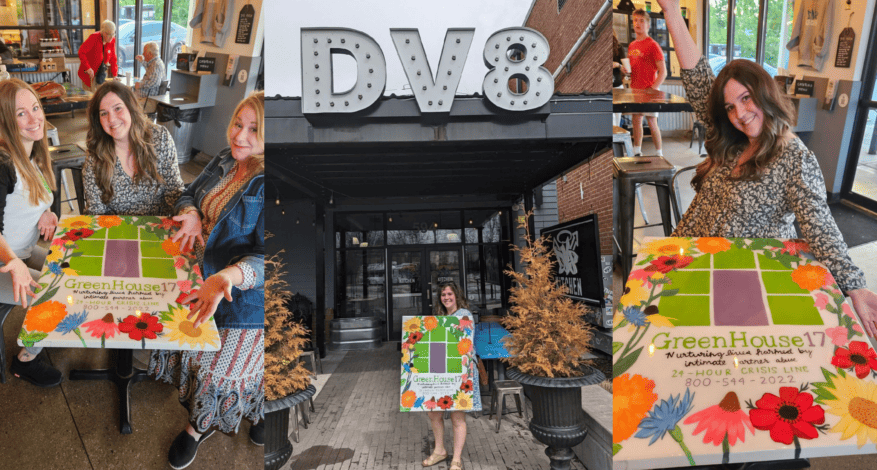
DV8 Kitchen Table Art Contest

We are excited to be participating in the Table Art Contest at DV8 Kitchen on Broadway! Your vote for our table could help us win up to $1500 to support services for survivors.

Eleven central Kentucky nonprofit organizations have partnered with local artists to create art directly on dining room tables at DV8 Kitchen on Broadway in Lexington. Videos from each participating organization are posted on social media, and every “like” on each video counts as a vote for that table.

Kristin Carpenter, an artist on our staff, imagined and painted the beautiful table featuring our mission. She and Reena Martin, our Community Engagement Manager, were interviewed about the meaning behind our table’s design.

Follow this link to the DV8 Facebook Page to like our vido and cast your vote for our table.

While you’re there, be sure to check out other videos featuring the tables and missions of these amazing sobriety organizations in the nonprofit community:

  • Hope Center / Anonymous
  • NAMI / Julie Joseph
  • Chrysalis House / Destinee Austin
  • Voices of Hope / Yolanda Kennison
  • KORE / Dawna Scripps
  • Natalie’s Sisters / Landrie Nickell
  • Shepherd’s House / Michael Harper
  • OWL / Jennifer Bacon
  • Grin Grant / Melody Jackson
  • New Vista / Keaton Young

Winners of the contest will be announced during a special event on April 26 from 5:30 – 8:30 pm at the DV8 Kitchen Broadway location. The restaurant will be open to the public, offering its full menu for dinner and live music. The event is supported by CHI Saint Joseph Health, Truist and LexArts.

Follow this link to cast your vote!

The link above will take you to our video on the DV8 Facebook page.

READ MORE
aisley autumnBlog

Aisley Autumn

Aisley Autumn first connected with us five years ago when she performed at the ribbon-cutting event for the Children’s Safe Exchange and Visitation program.

“I was really moved by your mission,” she shares.

While talking with staff after the event, Aisley shared that she had written a song called “Set Her Free” that was inspired by her mother, a survivor of intimate partner abuse before meeting Aisley’s dad.

“My mom had told me stories about the emotional toll, how trapped she felt, and how freeing it was to escape that dangerous situation.”

Her broken smile and eyes to the floor
She can’t decide what’ll hurt her more
The truth is she’s not alright
But she’ll hide it in another lie

Aisley has since performed “Set Her Free” during two LUNAFEST Lexington events. In 2018, Aisley made her international radio and television debut on WoodSongs Old-Time Radio Hour alongside Chris Barron of the Spin Doctors.

She will graduate from the University of Kentucky this spring with marketing and vocal performance degrees.

Her first single, “Just Be,” was recently released on Spotify, and she is working with a team in Nashville to begin her career as a professional singer-songwriter.

“As a musician, I think about how I can best serve and uplift others through my music. I’m so thankful for your all’s encouragement and support of me as a songwriter. You have genuinely changed my life for the better.”

Read the Spring 2023 issue of Bloom

This is one article from our print newsletter. Follow the link above to read the full issue!

READ MORE