Battered Women’s Movement

Domestic violence was seldom a topic of public discourse before 1970.

Only 50 years have passed since grassroots rallies, known then as the Battered Women’s Movement, began to raise awareness and call for change. Two decades would pass before the Violence Against Women Act established domestic violence as a federal crime in 1994.  

The Women’s Liberation Movement set the stage for the Battered Women’s Movement, or Domestic Violence Movement, which began in the early 1970s. 

We Will Not Be Beaten 

In the early 1970s, there was little to no help for people who wanted to leave their partners due to intimate partner abuse. Domestic violence was often not taken seriously by law enforcement and the legal system.  

Led by feminist activists and survivors of intimate partner abuse, the Battered Women’s Movement used the slogan, “we will not be beaten.” 

They sought to raise public awareness, provide support and resources for survivors, and advocate for policy changes. The term domestic violence became more widely accepted and was seen as a more accurate and inclusive way of describing abuse in relationships. 

Early 1970s 

There were very few organizations for survivors – the first shelter was Women’s Advocates in Minnesota (est. 1972). They started as a divorce rights information line and as laws changed, raised funds to establish a permanent shelter in 1974.  

1976 

Del Martin published ‘Battered Wives,’ an analysis of domestic violence, its seriousness, and how the legal system had failed women.

In 1978, the grassroots movement evolved into something more formal. 

1978 

The United States Commission on Civil Rights held the Consultation on Battered Women: Issues of Public Policy. Del Martin chaired the meeting and two big events happened: 

  1. The National Coalition Against Domestic Violence is formed. 
  2. The Commission on Civil Rights publishes Under the Rule of Thumb: Battered Women and the Administration of Justice.  
Late 1970s 

Domestic violence shelters begin opening across the United States. Kentucky’s first shelter opened in 1977 and by 1980, there were six. The Kentucky Coalition Against Domestic Violence, recently renamed ZeroV, was founded in 1981 by staff at these shelters.  

1981 

The National Coalition Against Domestic Violence declares a national day of unity on behalf of survivors on October 17th. This eventually becomes Domestic Violence Awareness Month in 1987. 

1984 

President Ronald Reagan signed The Victims of Crime Act (VOCA) into law and established the Crime Victims Fund in 1984. Millions of federal criminal fines and penalties are deposited into the fund each year, and these dollars are granted to public and nonprofit providers for supportive services for victims of crimes. 

The Family Violence Prevention and Services Act supports victims of domestic violence and their children and is the only federal funding source dedicated to domestic violence shelters and programs. 

1981 

The National Coalition Against Domestic Violence declares a national day of unity on behalf of survivors on October 17th. This eventually becomes Domestic Violence Awareness Month in 1987. 

1984 

President Ronald Reagan signed The Victims of Crime Act (VOCA) into law and established the Crime Victims Fund in 1984. Millions of federal criminal fines and penalties are deposited into the fund each year, and these dollars are granted to public and nonprofit providers for supportive services for victims of crimes. 

The Family Violence Prevention and Services Act supports victims of domestic violence and their children and is the only federal funding source dedicated to domestic violence shelters and programs. 

1985  

Tracey Thurman wins a lawsuit that strengthens protections for domestic violence survivors.  

She endured years of physical and emotional abuse from her husband and repeatedly sought help from law enforcement.  

Tracey won the lawsuit against the Torrington Police Department, and it resulted in the Family Violence Prevention and Response Act, or Thurman Law. It required police to make an arrest in domestic violence cases. 

1994  

Congress passes the Violence Against Women Act (VAWA), which was designed to prevent gender-based violence, including domestic violence, sexual assault, and stalking. VAWA provides funding for services of victims such as hotlines, shelters, legal services, and law enforcement training. 

OJ Simpson Trial gets people talking about domestic violence. It was a shift in awareness and public willingness to discuss the issue. 

More Recent Years 

VAWA has been reauthorized a number of times. The most recent Violence Against Women Act Reauthorization Act was signed in 2022 and all current VAWA grant programs are authorized until 2027.  

In 2009, Vice President Biden, who wrote VAWA, announced Lynn Rosenthal as the new White House Advisor on Violence Against Women. 

The “me too” movement, founded by Tarana Burke, was created to highlight the violence experienced by marginalized women. Along the way, it brought international attention to the universal prevalence of sexual violence.   

Although there is increased awareness of domestic violence, better laws and policies, and lots of support services, intimate partner abuse still affects one in three women and one in four men in Kentucky.  

What Can You Do 

We all must do our part to speak out against intimate partner abuse, be active bystanders, and correct inappropriate language when we hear someone victim-blaming. Remember that your voice is powerful

READ MORE
kids talking to advocate alyssa at hollergirlBlog

HollerGirl Music Festival

HollerGirl is a female-forward music festival that focuses on healing from domestic violence.

We were honored to be a part of the new HollerGirl Music Festival last year!  

Our community supports survivors in such unique ways, and we want to share more about this exciting event. 

This year the festival will take place August 11 – 13 at Rockcastle Riverside Campground 

The lineup includes Senora May, Bee Taylor, and so many other amazing female artists.

hollergirl lineup

Find more information, purchase tickets, or become a vendor by visiting their website here and follow along with them on Facebook here. 

Founder Kristen McClure sat down with us to discuss the festival and how it came to be.  

The Inspiration 

HollerGirl came from the idea of my passion for local music, highlighting women who get overlooked, and bringing in domestic violence is very important to me. 

I fell in love with the whole idea of music festivals and how wonderful they can be. Then I started thinking about all the talented female musicians we have here locally and how little I actually saw them on the bills, especially as headliners. 

The idea of HollerGirl came to me in February last year and I executed the idea in August. 

Women need to be heard. The local musicians we have around here are incredible. 

I wanted to combine the idea of highlighting female musicians with raising awareness for domestic violence survivors. I am a domestic violence survivor myself and my grandmother was also a survivor. 

That’s how GreenHouse17 came to be involved. My other main passion is GreenHouse17. I want to raise awareness. 

Family Friendly 

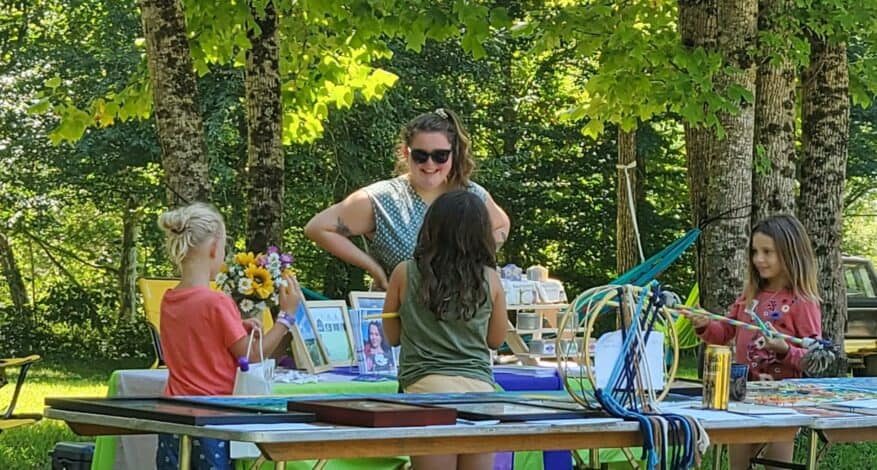
The festival is family-friendly and there will be kids’ activities. 

It’s super important to me that my children, they’re 8 and 10, are surrounded by this sort of atmosphere where women are empowered. It’s important to me for this festival to encourage kids to be strong and understand their place on this earth and what it means to be a good person. 

And understand the impact of what domestic violence means. That they can heal. I want to inspire them with seeing women on the stage. I want little girls to look up there and go, I can do that, too. 

The Location 

The space is Rockcastle Riverside. The river’s right there. It’s in the heat of August so people can walk down to that little sandy beach and get into the river. People are kayaking and kids are playing in the shallow area. 

Workshops, Art Auction, Local Artisans 

We’re going to have workshops this year.  

Cecilia Blair Wright is playing the festival and is also going to be doing music therapy. We’ll have a community art piece with GreenHouse17 and a writing workshop with Amy Figgs. 

There’s also an art auction and local women artisans. 

Open Mic Sunday 

This is a safe space. The open mic is going to be about release, healing, and inspiration. I think it’s an important part of healing from trauma. 

I had so many people coming up to me after the event and saying how special it was to them. People told me, ‘I don’t tell anybody this, but this happened to me. I’m so glad that you’re saying something.’ 

If they want to get up there and scream, sing a song, read poetry, or just say something, do it. 

image
image
image

Click here to read more.

Learn more about HollerGirl!

READ MORE
Blog

Shelter Life – Launching Phase

Walking into shelter for the first time can be a very scary experience.

Although every survivor’s journey after fleeing abuse is unique, our shelter services are designed around three phases of shelter life — Welcoming, Healing, and Launching. This is part three of a 3-part blog series that explores common activities during each phase.   

Launching 

When a survivor begins preparations to leave the shelter, they continue to work with their Healing Advocate and also choose another advocate to help during the Launching phase. 

Housing 

Although each survivor needs different types of housing support, most receive temporary rental and utility assistance. 

Some survivors transition to apartments in their home county or near supportive family and friends, while others move to apartments in the ZeroV Homes Lexington. Twelve of these units are scattered near downtown Lexington, with easy access to public transportation, and twelve cottage-style duplexes are nestled on the backside of the emergency shelter’s property.  

Breaking Down Fears 

A large part of the Launching phase is to work on emotional support. For a lot of survivors, this is the first time they’ve lived on their own in a long time.  

Advocates will work through fears and safety plan for survivors. If the survivor has children, our Youth Advocate will help safety plan with the kids. 

What’s Next? 

While a survivor is still at shelter, Launching Advocates will connect them with an Outreach Advocate in the community where they will be living. Staff members live and work in all 17 counties of our service area. 

Outreach Advocates continue supporting survivors after they transition out of shelter.  

Call us anytime.

24-HOUR HOTLINE 800.544.2022

READ MORE
scott with children21 Years

Teen Dating Violence Awareness – Part 2

February is Teen Dating Violence Awareness and Prevention Month.

The theme is, “Be About It,” encouraging everyone to help create a world free from relationship abuse. It’s important to start talking to your children about intimate partner abuse early and often.  

Scott, the program manager for our Children’s Safe Exchange and Visitation, shared how he discusses his work and topics surrounding intimate partner abuse with his son, who is about to turn 13. 

I have been working with traumatized youth in various residential facilities since the winter of 1995. As a parent, I feel that I have an advantage in talking to my son about intense issues since most parents’ “intense” feels like my Tuesday. That’s certainly not entirely true, but that’s how it feels sometimes when I talk to parents who aren’t social work lifers.  

My advantages are compounded by my spouse who is an Intervention Specialist working at VIP [Violence Intervention and Prevention Center] on UK’s campus. Most of her work is centered on sexual assault. 

My son will be 13 this April. He has been subjected to post-work debriefings between my wife and me for the past 12 years. There is not a lot he hasn’t heard. The good news is talking to him about intimate partner abuse, consent, sexual assault, etc. already has some built-in context.  

When we need to approach an issue with him, it usually develops organically. Most of the time he reports from YouTube, or we overhear something he is watching and try to be pretty frank with him.  

Despite the built-in context, it can still be difficult as my son is on the Autism Spectrum and does not give the cues we normally need to tell us the message is received and registered. I am direct, frank, and approach as if I’m talking to a dear friend. 

Sometimes we get cues that he is on board with what we are saying. The other day I trimmed my beard and my son says, “Hey dad, please don’t be mad…but you look like Andrew Tate.”  

I don’t at all, but I know he’s paying attention. 

Call our 24-Hour Crisis Hotline

If you or someone you know is being abused, our advocates are available every day of the year.

READ MORE
teenagers field making hearts with handsBlog

Teen Dating Violence Awareness – Part 1

February is Teen Dating Violence Awareness and Prevention Month.

TDVAM has me thinking about my past and my daughter’s future.  

It wasn’t until I started working at GreenHouse17 that I really reflected on my first high school relationship. And even more so after having my daughter in September.  

Although the details are fuzzy now, I remember enough to know I should’ve left my boyfriend when I was a sophomore/junior in high school. He showed many signs of abuse, even though he never hit me.  

He would physically restrain me by holding my wrists and yell at me in the halls of school. He also went on a hunger strike when I broke up with him at one point and convinced our friends it was a romantic gesture until I gave up and returned to the relationship. 

When I take this quiz about my high school relationship – Is your relationship healthy? – from love is respect, I get this response – 

 “If you scored 5 or more points, you are definitely seeing warning signs and may be in an abusive relationship. Remember the most important thing is your safety — consider making a safety plan. You don’t have to deal with this alone. Contact us at loveisrespect.org” 

I don’t want my daughter to end up in an unhealthy relationship. I want her to be knowledgeable about red flags and feel comfortable discussing these things with trusted people in her life. 

Start Early 

I plan to start talking to my daughter early. Starting discussions about bodily autonomy is important to prevent sexual abuse and later intimate partner abuse. This article from Rady Children’s Hospital discusses seven steps to teach your children about bodily autonomy. 

This parent guide from love is respect is a good resource to get conversations started with your teenager. 

Conversations 

I asked Scott, the program manager for our Children’s Safe Exchange and Visitation, how he discusses topics surrounding intimate partner abuse with his son, who is about to turn 13. 

Read what he shared here. 

Call our 24-Hour Crisis Hotline

If you or someone you know is being abused, our advocates are available every day of the year.

Photo by Melissa Askew on Unsplash

READ MORE
two people at front deskBlog

Shelter Life – Healing Phase

Walking into shelter for the first time can be a very scary experience.

Although every survivor’s journey after fleeing abuse is unique, our shelter services are designed around three phases of shelter life — Welcoming, Healing, and Launching. This is part two of a 3-part blog series that explores common activities during each phase.   

Healing 

“When clients first come in, they work on immediate safety goals – getting all their documents and making sure they have everything they need to basically start a new life,” says advocate Alyssa. 

“When they get to Healing, we work on long-term goals like employment, counseling, housing, legal advocacy, and setting up referrals to the community so they have support systems.” 

Advocate Kristen adds, “And also the emotional aspect of processing what brought you here. After you’re safe and have time to rest, all these feelings and realizations start coming out about your past trauma and we’re here to talk about that and find outlets that work best to regain self-sufficiency.” 

First Meeting 

During the first meeting with their Healing Advocate, survivors discuss their long-term goals during the remainder of their stay at shelter such as finding a job, housing, and transportation.  

Healing Advocates also talk through the survivor’s history and help them process their trauma. 

“We’re listeners and keepers of their stories while we work towards safety for their families,” says Alyssa. 

After the initial meeting, survivors and Healing Advocates meet at least twice a week to work towards their goals. 

Goals 

An important part of the Healing phase is making sure people are connected with support systems in their community like Legal Aid of the Bluegrass and the Children’s Safe Exchange and Visitation program.  

Every survivor’s healing journey is different, but common goals include reaching financial independence, going back to school, working out schedules for their children, and finding a therapist. 

What’s Next? 

When survivors are ready to begin their transition out of shelter, they move on to phase 3 – Launching.

Call us anytime.

24-HOUR HOTLINE 800.544.2022

READ MORE
Tiffany in front of flowersBlog

Shelter Life – Welcoming Phase

Walking into shelter for the first time can be a very scary experience.

Our advocates are always here to greet new families, answer crisis calls, and safety plan with survivors ready to flee.

Although every survivor’s journey after fleeing abuse is unique, our shelter services are designed around three phases of shelter life — Welcoming, Healing, and Launching. This will be a 3-part blog series that explores common activities during each phase. 

Welcoming 

“Welcoming is all about loving on you, showing you around, and giving you resources,” says advocate Tiffany.

When a survivor is coming to shelter, Welcoming Advocates get their room prepared and make a welcome bag with toiletries, hair products, washcloths, towels, and comforting items like fuzzy socks.  

When the new resident arrives, a Welcoming Advocate will give them a tour and introduce them to staff members.  

Intake

After they get settled in, it’s time for an official intake. An advocate will talk them through what community living is like at shelter.  

They’ll talk through the groups offered at shelter like Uke Can Do It and farm Make It Take It groups

Documentation & Court

A large part of a Welcoming Advocate’s job is making sure basic needs of survivors and their children are met so healing of physical and emotional wounds can begin. A lot of survivors must flee quickly, leaving everything including their social security card and driver’s license.  

Sometimes a survivor needs help with the emergency protective order (EPO) process and will need to go to court. The Welcoming team can help with this and get them connected with one of our Legal Advocates

What’s Next? 

If a survivor can move out of shelter to their own space, Welcoming Advocates will work to connect them with community resources like storage and moving companies. Sometimes the sheriff’s office will be able to install ring cameras at their new place for safety. 

If a survivor needs more time to get on their feet, they move on to phase 2 – Healing

Call us anytime.

24-HOUR HOTLINE 800.544.2022

READ MORE
Blog

Reflecting on 2022

As the year comes to a close, we are grateful for every day of safety and healing for each strong survivor. ⁣⁣

We’re sharing some of our favorite pictures from 2022 💜

January – Shelter was beautiful and snowy. Even in the worst weather, an advocate is always available to take your call – 800.544.2022
February – The annual Shop & Share event was amazing and we are grateful to every volunteer and shopper!
March – Takiyrah shared her story of survival in the Bloom newsletter.
April – A survivor living in shelter received her keys to transitional housing.
May – Started harvesting vegetables for delicious farm-to-table meals.
June – Enjoyed a small gathering with friends on the farm. A special thanks to Kate Horning and Kellen Macklin for a delicious farm-to-table dinner and mocktails.
July – Enjoyed a field day for survivors and kids. Thank you to Sweet Sisters for cooling down residents and staff with delicious shave ice!
August – Had an empowering time at the first HollerGirl Music Festival which supported survivors.
September – We held a gathering during the autumn equinox to celebrate abundance and acknowledge gratitude.
October – Our Purple Thursday staff photo. Thanks to everyone who participated to raise awareness!
November – A delicious Thanksgiving dinner with farm-to-table pies.
December – The International ‘We Serve’ Foundation planned a holiday party with dinner and gifts for all residents.
READ MORE
josh standing in front of GreenHouse17 signBlog

Running for Survivors

We are so lucky to have a generous community that cares about survivors.  

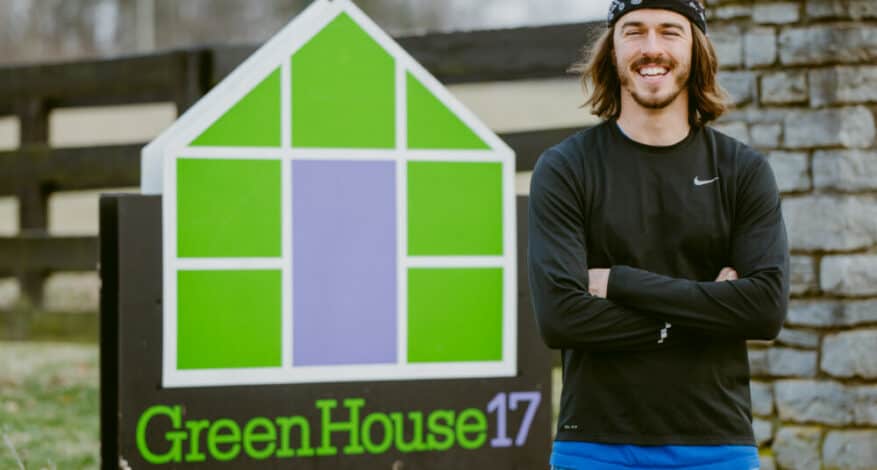
Josh Nadzam, Co-Founder and Board President of On the Move Art Studio, shares his personal connection with intimate partner abuse and how he uses his love of running to support survivors. 

Thank you, Josh!  

The first phone call I ever made was at 5 years old. I called 911 because my father was choking my mother up against a wall. Making a plea to the dispatcher was the most I could do then, but once I became an adult I was determined to do much more.

One way I could do this was by leveraging my ability to run to raise awareness for eradicating domestic violence and raise some funds for survivors along the way. After five years on the Track and Field and Cross Country Team at the University of Kentucky, I had quite a bit of training that prepared me to do just that.

My first attempt at this was in 2014 when I ran from Lexington to Frankfort (25.5 miles) for HB 8, a bill being considered to protect dating violence survivors in Kentucky. On March 6, 2014, “Josh’s Run to Frankfort” took place, running from the Fifth Third Pavilion to the steps of the capitol, raising nearly $5,000 along the way.

The second and third times I leveraged this ability was when I qualified for the Boston Marathon. I decided to dedicate each race to survivors of domestic violence, and created a campaign called Bluegrass to Boston for Survivors. In 2016 and in 2019 I asked friends and family to support me by making donations that would go to GreenHouse17, with the former raising $3,000 and the latter raising $2,215. Each time it was so incredible and moving to see so many people passionate about supporting survivors.   

Each one of us has at least one unique skill we can use to benefit others and help make the world a better place. Some of us can sing or draw, dance, play music, photograph the world, cook, or knit. I’m fortunate to be able to run and have been able to use that ability to try to rally support for survivors. I’m endlessly grateful that GreenHouse17 does the incredible work they do so that one day, no 5-year-old child will ever have to call 911 again to stop one parent from abusing the other. And because of GreenHouse17, I am certain we can accomplish this. 

image
image
image
image

*Images in front of the GreenHouse17 sign were taken by Ayna Lorenzo of Mothwing Photography

Click here to read more.

Learn more about On the Move Art Studio!

READ MORE
life adventure camp signBlog

Equine Therapy at the Life Adventure Center

Advocates are always brainstorming ways to connect survivors to the community for healing activities.  

We have a longtime partnership with the Life Adventure Center in Versailles where survivors have taken many trips over the years. The Life Adventure Center uses outdoor adventure to transform lives affected by trauma. They’ve also hosted a lot of our staff retreats.

Advocate Madison Haven recently took a group of residents there for an equine therapy session. 

Passionate about nature and connecting with animals as a form of healing, she was excited to facilitate this experience alongside a group of residents who grew up with horses and missed having that kind of connection with an animal. 

One resident said she had a horse when she was a little girl and riding again made her feel happy and at peace for the first time in a while.

Madison reflected, “It was an incredible experience to be able to observe the horses’ behaviors. To be present while brushing them, get to ride them, and work as a team to corral the horses while respecting them. It was a good lesson of patience and persistence while remaining gentle and understanding of the horse and its own free will and boundaries similar to our own.” 

image
image
image
image
READ MORE