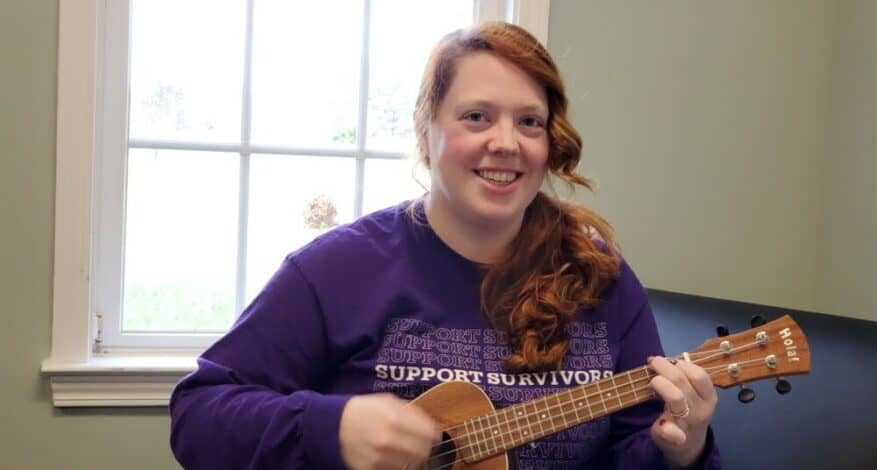
morgan holding ukuleleBlog

Healing through Music

Sometimes you’ll hear empowered singing and song playing echo down the halls of our emergency shelter.  

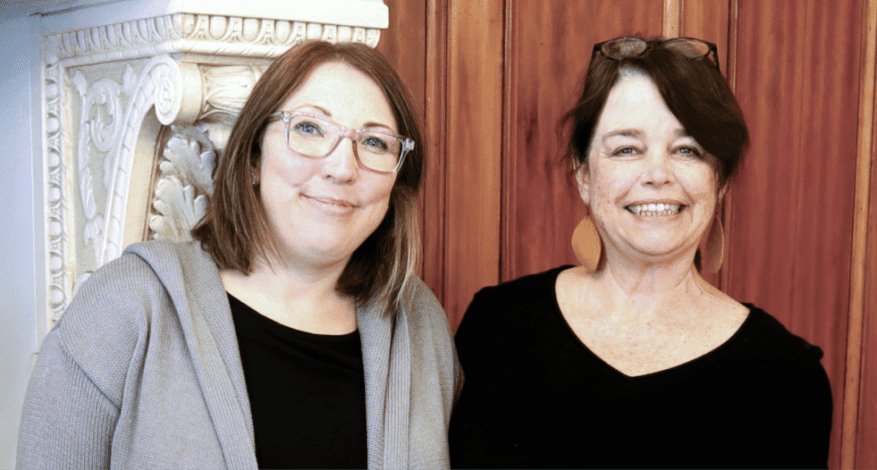
Healing through music is helpful for many people who have experienced trauma. Advocate Morgan hosts weekly ukulele sessions for survivors at shelter called, “Uke Can Do It.” It provides a safe space for survivors to express, process, and take back their power.

Morgan’s Background 

Morgan has always loved music and participated in choir from 4th grade through college at Morehead State. She was even a part of the choir that won the 2014 Mayo International Choral Festival in Ireland! 

While Morgan was working towards a music therapy degree at UK, she had a family violence class where Diane, our associate director, spoke. The talk really stuck with her and she switched her degree to a masters in social work.  

Her 2020 practicum was here at the shelter and she was hired as an advocate after she finished school. Morgan recently took a new position as the Children’s Advocate but is excited to keep doing the ukulele class for adults at shelter.  

Uke Can Do It 

Morgan enjoys picking out the songs she teaches to survivors. She looks at not only the song’s impact but also the message of the artist. In a recent class, the song learned was Elton John’s I’m Still Standing. Morgan and her mom recently went to the Elton John concert and she was inspired. 

At the end of each session, she saves time for lyric analysis.  

“Don’t you know I’m still standing better than I ever did?
Looking like a true survivor, feeling like a little kid
And I’m still standing after all this time
Picking up the pieces of my life without you on my mind”

The prompt to get a conversation started was, “For the people in your life who doubted you, what would you say to them?” 

Morgan says residents leave her sessions with a feeling of accomplishment. They learn so many things at once – chords, finger placements, reading music. She reminds them how much they accomplished in an hour, think of what you can do with a whole day! 

She also makes sure survivors know they don’t have to play. They can just listen and join in on the conversation if they want. Morgan often brings in her drums, tambourines, and shakers for those who aren’t yet comfortable learning a tune on the ukulele.  

ukulele and I'm Still Standing chords on music stand
READ MORE
How to Support Someone Who is Being Abused holding handBlog

How to Support Someone Who is Being Abused

How can you support someone who is being abused? Listen. Believe. Empower. Be informed. 

Learn & Listen

First, remember the abuse they are suffering is rooted in isolation, power, and control. Your role is to help them make their own decisions, not rescue them. Educate yourself on the power and control wheel.  

Believe the stories they tell you. Listen more than you talk. Avoid saying what you would do.  

Safety Plan

Say you are really worried about their safety and ask if they have a safety plan.  

Become familiar with things to consider when making a safety plan. Suggest that they call our 24-hour hotline to speak with an advocate. You can call us, too. We are here to answer questions and help you support your friend or family member. 

Not Just Shelter

Intimate partner abuse programs like ours aren’t just about emergency shelter. Certified Domestic Violence Advocates can help safety plan, help survivors through the emergency protective order process, accompany survivors to court, help with housing, connect them with support groups, plan next steps, or just talk.  

Remember Leaving Isn’t Easy

Always respect your friend or family member’s decision, even if they decide to stay. Sometimes it’s because leaving will be too dangerous right now. 

There are many reasons for not being able to leave – having nowhere to go, fear, financial insecurity, threats to themselves or their children or pets. Leaving the relationship is often the most dangerous time for the survivor.

Call us anytime.

24-HOUR HOTLINE 800.544.2022

READ MORE

The Depp v Heard Trial

The defamation trial of Johnny Depp versus Amber Heard has people talking about domestic violence.

Trigger Warning: This post includes descriptions of abuse that could be re-traumatizing for victims and survivors of abuse.

Evidence of violence

The trial finds Depp suing Heard because of this essay she wrote in The Washington Post about her experience as a victim of intimate partner abuse. Although not mentioned in the essay, Depp is suing Heard claiming the article is defamatory.

Several witnesses for the prosecution, including Depp, already have testified. Attorneys from both sides read and questioned text messages sent between and about the former couple. These messages revealed a pattern of aggressive name-calling and verbal violence.

Several video and audio recordings, many made without the other’s consent, also have been played during testimony. In one of the recordings, Depp accuses Heard of punching him. Heard acknowledges it happened but contends she didn’t hurt him. Other videos capture Depp yelling and slamming cabinets. He threatens to cut his wrists with a knife in another recording.

Mutual Abuse?

Media coverage has used terms like “mutual abuse” and “reactive abuse” to describe the violence. In a recent interview with NBC News, Ruth Glenn, President and CEO of the National Coalition Against Domestic Violence, spoke about the use of those terms.

“I don’t believe in mutual abuse. I don’t believe that two parties decide to meet in the kitchen and box it out,” Glenn said. “It just doesn’t sound right, reactive abuse. I’m going to abuse you as a reaction? No, I’m going to defend myself as a reaction.”

Advocates in the mission to end intimate partner abuse know that violence is rooted in power and control. Although behaviors from both partners can be abusive, one person tends to have more control in the relationship than the other. Tactics such as emotional abuse, isolation, and threats often accompany physical abuse.

Abusers also minimize, deny, and blame others, especially to leverage support from third parties.

Blame Shifting

The National Domestic Violence Hotline website offers more insight on blame-shifting.

“Sometimes the justifications sound really good. Especially when we’re looking for something — anything — to help make sense of how the person we care for is acting toward us. It’s normal to want to rationalize what’s going on because abuse is pretty irrational.”

“We often want to find reasons because we don’t have any real data on why abusers do what they do,” Glenn said during the NBC interview. “I think we find many different ways to make it OK in our heads that somebody can be abusive.”

Legal advocates for survivors, many of whom have spent hundreds of hours in courtrooms listening to testimonies, also understand that abusers often attempt to shift the blame to victims, especially when victims have reacted physically in self-defense.

Public Opinion

Although the trial is not about establishing whether the abuse happened, or who abused whom, public opinion abounds. A recent Google search returned more than a hundred million web links to the topic.

Supporters of Depp believe Heard was the primary aggressor, and she shifted blame to Depp as the victim.They point to an absence of physical abuse in Depp’s previous relationships, which has been backed by the testimony of former partners. Testimony also revealed that Depp’s mother physically, emotionally, and verbally him as a child and also abused their father.

Supporters of Heard say the prosecution’s testimonies do not invalidate her claims of abuse. Heard believes she has a right to tell her story — in private and public. The defense is expected to present their evidence and arguments in the coming days.

Taking Sides

Given the frequency of intimate partner abuse, it’s likely you’ve struggled with many of these same questions when supporting a friend or family member who was being abused. Maybe this very public trial will help us to better understand power and control and, in turn, more deeply consider the complexities of intimate partner abuse.

24-Hour Hotline

Call 800.544.2022 to speak with a domestic violence advocate.

READ MORE
green dot logoBlog

Green Dot

Small actions for a safer city

What is Green Dot?  

First, imagine a map of your city. Red dots are the issues. They’re incidences of things like intimate partner abuse, sexual violence, and elder abuse. Green Dots on the map represent acts of responding to the red dots.  

map with red and green dots

Green Dot works to educate, empower, and unite community members in the collective mission of cultivating a safer city through bystander intervention. It’s a nationally recognized violence prevention strategy focused on preventing power-based personal violence – sexual violence, intimate partner violence, child abuse, elder abuse, bullying, and stalking. 

Green Dot teaches community members how to intervene and cover those red dots with green ones.  

Training 

You can learn to be an active bystander through an online, interactive training led by Dawn Runyon, Green Dot Education Program Specialist at LFUCG.  

This training will teach you how to intervene by using the 3 D’s.  

  • Direct – Being direct with the person doing harm or person being harmed. Asking “are you ok?” or saying “that’s not appropriate.” 
  • Distract – Divert attention away. Start a random conversation, spill a drink, or start your car alarm. 
  • Delegate – Seek assistance from someone else to help. Tell a bartender, a teacher, or start recording a video.  

The community training provides example situations and participants brainstorm on how to Direct, Distract, or Delegate.  

The next training is on Tuesday, April 19th from 3pm to 5pm. To sign up, see the pinned post on their Facebook page 

Show Your Support

How else can you support your community and show you do not tolerate harmful acts?  

  • Wear branded gear in public to show support. You get a free t-shirt for finishing active bystander training!  
  • Share information on social media and use the hashtags #beanactivebystander #knowhow2act #greendotlex. You can find Green Dot on Facebook here and Instagram here.  

Read more!

Exciting news for Green Dot and the community!

READ MORE
sexual assault awareness and prevention monthBlog

Sexual Assault Awareness & Prevention Month

Between 14% and 25% of women are sexually assaulted by intimate partners during their relationship.

April is Sexual Assault Awareness and Prevention Month. Many abusers who are physically violent are also sexually abusive. 

Here are 7 statistics about the intersection of intimate partner abuse and sexual abuse from the National Coalition Against Domestic Violence. 

7 Statistics About Domestic Violence and Sexual Abuse

  1. Intimate partner sexual assault and rape are used to intimidate, control and demean victims and survivors of domestic violence. 
  2. Intimate partner sexual assault is more likely than stranger or acquaintance assault to cause physical injury.
  3. Between 14% and 25% of women are sexually assaulted by intimate partners during their relationship.
  4. Between 40% and 45% of women in abusive relationships will also be sexually assaulted during the course of the relationship. 
  5. Over half of women raped by an intimate partner were sexually assaulted multiple times by the same partner. 
  6. Women who are sexually abused by intimate partners report more risk factors for intimate partner homicides than non-sexually abused women.
  7. Women who are sexually abused by intimate partners suffer severe and long-lasting physical and mental health problems, similar to those of other rape victims. They have higher rates of depression and anxiety than women who were either raped by a non-intimate partner or physically but not sexually abused by an intimate partner. 

Ampersand Sexual Violence Resource Center of the Bluegrass

Our friends at Ampersand will be sharing information and hosting events this month for Sexual Assault Awareness & Prevention Month.

Ampersand’s focus is to support folks who have been impacted by violence and to engage the community in changing rape culture. We serve the same 17 counties – Anderson, Bourbon, Boyle, Clark, Estill, Fayette, Franklin, Garrard, Harrison, Jessamine, Lincoln, Madison, Mercer, Nicholas, Powell, Scott, and Woodford. 

#SAAPM

Get more information on Ampersand's website

READ MORE
safe exchange toysBlog

Children’s Safe Exchange & Visitation

Nearly 10,000 safe visitations and exchanges have been provided since the program began in 2018.

The Children’s Safe Exchange and Visitation program was launched in 2018 to support children whose parents and families have a history of intimate partner abuse, substance use, child abuse, or neglect.

Nearly 10,000 safe visitations and exchanges have been provided since the program began. Services are provided from two locations in downtown Lexington and Georgetown. Visitations and exchanges are facilitated without contact between adult parties so children and parents can feel safe while building positive parent-child relationships.

Children’s Safe Exchange and Visitation is a unique place where young survivors can have some time together with their families in a safe and warm environment,” shares Scott Lancaster, program manager.

Services honor the importance of the parent-child relationship in the healthy development of children while committing to safety and reducing worry about conflict.

AU Associates, Inc. donates the program’s Lexington office space, while Georgetown Police Department provides in-kind space for services in Scott County.

Read the Winter 2022 Issue of Bloom 💜

This is one article from our print newsletter. Follow the link above to read the full issue!

READ MORE
Blog

Domestic and Sexual Violence Prevention Council

The Lexington-Fayette Domestic and Sexual Violence Prevention Council (DSVPC) represents a collaboration of individuals and organizations committed to ending domestic violence, dating violence, sexual assault, and stalking.

It really requires a community effort,” explains Stephanie Theakston, program coordinator. “GreenHouse17 has been a part of the coalition since the beginning and has informed so much of our work about specific needs of survivors.”

Recent awareness projects such as Wake Up Lex and Peace Pumpkins engaged local businesses, while the Green Dot violence prevention program trains individuals to be active bystanders.

I think we do better work when we do it in partnership with one another. It makes the sharing of information easier,” shares Diane Fleet, our associate director and current chair of the DSVPC Board of Directors.

Read the Winter 2022 Issue of Bloom 💜

This is one article from our print newsletter. Follow the link above to read the full issue!

READ MORE
road reads passion led us hereBlog

Social Work Month

The Time is Right for Social Work

It’s Social Work Month! The National Association of Social Workers (NASW) is celebrating in March with the theme “The Time is Right for Social Work.” This theme underscores the contributions social workers have made to this nation for more than a century and how their services continue to be needed today.  

This annual campaign is a time to inform the public, policymakers, and legislators about the services social workers provide in an array of sectors – including nonprofits like ours, mental health centers, schools, and community centers.  

People become social workers because they have a strong desire to help others and make our society a better place to live for all. They have helped drive significant, positive changes in our nation.   

Social workers such as social reformer Jane Addams, former Labor Secretary Frances Perkins, and civil rights leaders Dorothy Height, Whitney Young and Ida B. Wells have pushed for voting rights, equal rights, Social Security, unemployment insurance, and other programs.  

Social workers touch millions of lives each day and it is likely one at some time will assist you, a family member, or a friend.  

We couldn’t be more grateful for the good work that social workers do for survivors, our community, and our world. Be sure to thank a social worker for their hard work and dedication! They make the world a better place.

Test Your Knowledge

Take a quiz on the history of social work and the services that social workers provide.

READ MORE
support group sitting downBlog

Support Groups

Surviving intimate partner abuse is a traumatic experience and it helps to have a safe place to talk about it. 

Support groups offer a safe and caring space so you don’t have to heal alone. You may not have many friends or family you can turn to for support, or maybe you’re having a difficult time trusting or relying on them right now. We know everyone’s story is different, but sometimes sharing with others who have been through similar experiences can offer comfort. 

Some benefits of support groups include the following:  

  • Feeling less lonely or isolated  
  • Talking openly and honestly about feelings  
  • Connecting with others who have shared experiences  
  • Improving coping skills  
  • Staying motivated   
  • Improving hopefulness  
  • Receiving practical feedback  
  • Learning about new resources 

It’s important to note the difference between a support group and group therapy. The term therapy usually means an intervention related to a physical or mental medical diagnosis. Support groups are gatherings of people with shared experiences. Our groups are facilitated by a Certified Domestic Violence Advocate.  


Our Support Groups
 

Most of our groups focus on common survivor experiences, but some focus on specific topics, such as co-parenting or finance matters. Both in-person and online meetings are available. 

You are not alone. It can be a struggle to talk about your story. Join a community of people who have experienced similar life events. You will get through this and you will heal.

READ MORE
21 Years

Takiyrah’s Story

“It’s not over, but I also know I’m not afraid anymore.”

I was established in Chicago. I had my own childcare facility, condo, and car. I was in college at the time and wasn’t into the whole dating scene.

He was super persistent and very handsome. He just wore me down. It was a typical relationship in the beginning. But there were little red flags.

He was very jealous. I just brushed it off because in the African American community, having a jealous boyfriend is a win. Then he started popping up at my house at 3 in the morning—popping up at my job.

I told him it’s over but found out I was pregnant. He came to my house and said, “You’re stuck with me until the child is 18.”

When I had my daughter, I moved an hour away. It was my first attempt to get away from him. Everything settled, but I began to feel like somebody was watching me.

Then I saw him one day. It was like seeing a ghost. He was living in a building across from mine. He could see my bedroom light and when I came or left.

He started showing up at my apartment. I called the police so many times. I would yell and scream. No one would help, even though my nose is busted and my eyes are black.

By the grace of God, I finally got an EPO and moved to Lexington. On lunch at work, I met this girl who told me about this place. A conversation with a stranger can change your whole life.

I got a call one day at my hotel. It was him. GreenHouse17 moved me to a different hotel and said we have a room at shelter.

They helped me heal physically and mentally. You don’t have to have all the answers. There’s still trauma and pain there. I know that I have a team of people. If I need anything, they will support me and my children. It’s not over, but I also know I’m not afraid anymore.

This is the first time I can tell my story and not cry. I want to show my son that’s not how women are treated. I want my daughter to grow up and recognize red flags. I will not let my children be victims. My strength, my faith, is about breaking the cycle – not just for my family, but for any woman and any woman of color.

This is only part of Takiyrah’s story, in her own words, shared with her permission.

Read the Winter 2022 Issue of Bloom 💜

This is one article from our print newsletter. Follow the link above to read the full issue!

READ MORE