Blog

Visit our table at DV8 Kitchen!

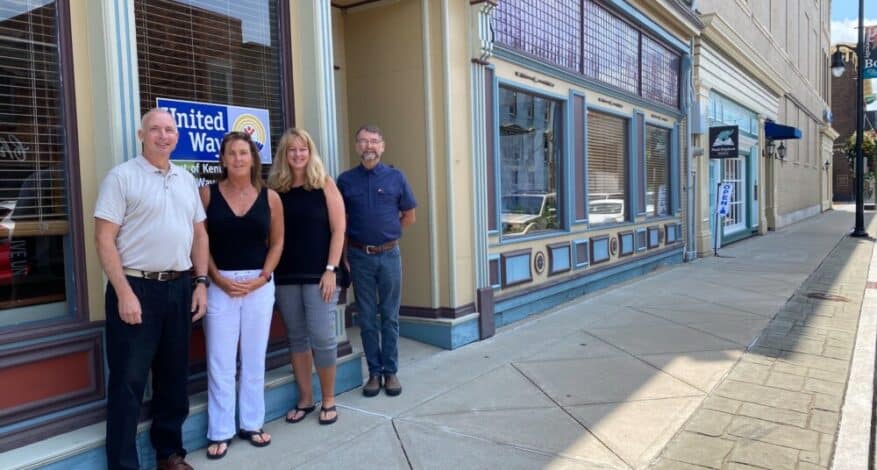
DV8 Kitchen’s new location is now open and you can eat at the GreenHouse17 table!  

In February, DV8 Kitchen invited 14 nonprofit organizations in the recovery community to paint a table for their new location in Lexington’s East End – 594 E Third St #100. 

Kristin Carpenter, a local artist and member of our staff, painted ours! Her original painting illustrates the benefits of nature-based healing. Lots of sunshine and water nourish flowers and vegetables to grow strong and stand tall in the fields. Our 24-hour hotline in the bottom right corner of the table will help survivors to connect with supportive services. 

DV8 Kitchen is a local restaurant & bakery that employs people in recovery from substance use disorder who are trying to redirect their lives. Their original location on South Broadway has thrived since opening in August 2017.  

The work of DV8 Kitchen is especially important to our mission. Many survivors struggle with substance use while healing from intimate partner abuse. A strong and supportive community is crucial for those on the path to healing and sobriety. 

If you eat at our table, please tag us on social media so we can share it!

READ MORE
ribbon cuttingBlog

Celebrating Three Years of the Children’s Safe Exchange & Visitation Program

Nurturing Young Lives

Three years ago on August 23rd, staff and community partners gathered to launch our Children’s Safe Exchange and Visitation program. Continuation of these vital services was necessary after the closure of Sunflower Kids.

More than 8,000 safe visitations and exchanges have been provided since the ribbon-cutting ceremony. Services are provided from two locations in downtown Lexington and Georgetown.

“Children deserve connection and bonding without worrying about conflict, intimidation, control, and further abuse,” says Darlene Thomas, Executive Director.  

Visitation and monitored exchanges are facilitated without contact between adult parties, keeping program participants safe throughout the process. This is also beneficial to the children so they do not have to potentially witness any intimidation, manipulation, or abuse between parents.  

Thank You 

AU Associates donates the program’s Lexington office space, while Georgetown Police provides in-kind space for services in Scott County.  Partnerships with Lexington Police, Friend of the Court, and Family Court judges also support the program.

Startup funds were provided by LFUCG Department of Social Services, through the Department of Special Grants and Programs.

Primary funding for the program now comes from VOCA – Victims of Crime Act – awarded through the Kentucky Justice and Public Safety Cabinet by the U.S. Department of Justice.

image
image

More Information About the Children's Safe Exchange and Visitation Program

For FAQ or to request an intake for this program, click the link above.

This project was supported by Grant Number VOCA-2020-GreenHouse-00109 awarded through the Kentucky Justice and Public Safety Cabinet by the U.S. Department of Justice. The opinions, findings, conclusions, and recommendations expressed in this publication/program/exhibition are those of the author(s) and do not necessarily reflect the views of the Kentucky Justice and Public Safety Cabinet or the U.S. Department of Justice.

READ MORE
purple image hand on throatBlog

What We Know About Strangulation

Many people will experience intimate partner violence in their lifetime, and of those, up to 68 percent will suffer near-fatal strangulation by their abuser.

In a recent conversation with legal advocate Stephanie Love, I asked what trends she has noticed over the years in the court system. She talked about strangulation and how it has only been considered a felony since summer 2019 in Kentucky. 

ZeroV, The Mary Byron ProjectLou Anna Red Corn, and many others worked hard to advocate for Senate Bill 70 to be passed and make strangulation a felony in Kentucky. 

Up to 68 percent of intimate partner abuse victims will suffer near-fatal strangulation by their abuser. Some people mistakenly use the word ‘choking,’ but this is a crime meant to stop the victim from breathing.

Defining Strangulation and What it Means for Survivors

The Training Institute on Strangulation Prevention defines strangulation as “the obstruction of blood vessels and/or airflow in the neck resulting in asphyxia.” This type of assault can have serious, permanent, or even fatal damage to the victim’s throat or brain. Symptoms include: 

  • Loss of memory 
  • Loss of consciousness 
  • Chest pain 
  • Bruising on neck 
  • Unable to speak or swallow 

For more signs and symptoms, click here. Warning – this is a very graphic poster, although it’s not a real person depicted.

This crime is often missed by law enforcement and medical professionals because in more than half of cases, there are no visible signs.  The National Domestic Violence Hotline reports that strangulation is a significant predictor of future lethal violence.

If someone has been strangled by a partner in the past, the risk of being killed by that partner is seven times higher.

Get Help

Do you fear your partner will strangle you or worry about the long-term effects of previous strangulation abuse? We will answer your call 24 hours a day, every day of the year – 800-544-2022. 

The featured image was inspired by MobileODT.

Further Reading

Click the link above to open a brochure from Alliance for Hope International about strangulation. There is a ‘visible signs’ drawing that is graphic included on the brochure.

READ MORE
Tabitha Dial in front of flowers in the hoop houseBlog

Magical Connections with Tabitha Dial

“When I think about my intuitive reading and your mission, the word magical comes to mind,” Tabitha Dial says. “We’re both caring about the community, as well as the individual, to support them in finding their voice.” 

When Tabitha Dial, an intuitive tarot and tea leaf reader, moved from Colorado to Lexington six years ago, she felt called to support our mission. 

“I have known a few women who have revealed their stories of domestic partner abuse to me, and I know there are many, many unheard stories that remain.” 

Tabitha began her support by offering donation-based readings at Third Street Stuff. Since then, she’s been one of our most engaged social media followers and always finds creative ways to celebrate nature-based healing on social media. 

While a member of the Autumn Vegetable and Herb CSA, Tabitha was inspired to write “Green Soup,” an award-winning poem featured in Kentucky Monthly’s Annual Writers’ Showcase. 

“When I think about my intuitive reading and your mission, the word magical comes to mind,” she says. “We’re both caring about the community, as well as the individual, to support them in finding their voice.” 

Read the summer issue of Bloom!

This is one article from our print newsletter. Follow the link above to read the full issue!

READ MORE
Kellen in front of plants in hoop houseBlog

Facebook Fundraisers – It’s so easy!

“I believe it’s a cause that deserves more awareness.”

For the past two years, around the time of his birthday, Kellen Macklin launched Facebook Fundraisers to ask his friends and family to make a donation to support GreenHouse17. His efforts have collected $1,250 to support our mission.

“My life hasn’t directly been affected by domestic violence, but I’ve been very close to people whose lives have been for many years. I believe it’s a cause that deserves more awareness.” 

“I was initially pretty apprehensive about using Facebook Fundraisers, but it’s so simple. Maybe takes 30 seconds to set up everything.” 

Donors can choose if their donations are public or private, and Facebook covers processing fees for gifts made to registered charitable organizations. When the fundraiser ends, donations are deposited directly to the organization’s bank account. 

“Even if you only raise a few dollars for whatever organization you choose, it’s more than they had before.”  

Kellen also supports us in other ways. Many nights while bartending at Arcadium in Lexington, he wears a purple mask with the words “support survivors” to spark conversations about our mission. 

This article was included in our print newsletter, Bloom. To read all the articles, click here.

READ MORE
welcome mat in front of doorBlog

Home Safe Home

Starting over after abuse takes time. 

Survivors often leave behind more than a home. Many begin again without furniture, clothing, and a vehicle. Sometimes the abuser has maintained power and control by not allowing a survivor to work or sabotaging their employment. Housing advocates help with these challenges.

“I have no family support and had nowhere to go,” shares a survivor who asked to remain anonymous. “I couldn’t afford daycare to work full-time and provide as a single mom.” 

While beginning to heal from the physical and emotional wounds of abuse, survivors meet with housing advocates to create an individualized housing plan. Early conversations imagine possibilities and identify barriers. 

Legal advocacy, credit repair, benefit applications, and budgeting assistance begin to chip away the obstacles. Partnering organizations provide job search, childcare, and other resources to help make the transition possible. Although each survivor needs different types of housing support, most receive temporary rental and utility assistance. 

Some survivors transition to apartments in their home county or near supportive family and friends, while others move to apartments in KCADV Homes Lexington. Twelve of these units are scattered near downtown Lexington, with easy access to public transportation, and twelve cottage-style duplexes are nestled on the backside of the emergency shelter’s property. 

Our housing team partners with dozens of organizations, companies, and landlords to support survivors during the transition to safe, affordable housing. Jubilee Jobs of Lexington offers job search services; Habitat for Humanity ReStore provides vouchers for furniture purchases; and Wildcat Moving, 2 Dudes Moving, and College HUNKS Moving offer services at no cost or reduced fees. 

“I always felt supported while in the program, and my abuser never knew where to find me. I can feel safe and my children can, too.” 

Read the summer issue of Bloom

This is one article from our print newsletter. Follow the link above to read the full issue!

READ MORE
Sharon and Darlene before the interviewBlog

Unapologetically Woman

Sharon Price, Executive Director of Community Action Council, is celebrating phenomenal women across Kentucky who make no apologies for their perspectives.

Darlene Thomas, our Executive Director, recently was nominated to be interviewed by Sharon and share her story about advocating for survivors of intimate partner abuse. Bits of the interview have been captured here, with the full interview video available.

Finding the Mission

I started doing this work about 32 years ago in western Kentucky, Louisville, and then there was an opportunity to start this program in Lexington 17 years ago.

I was fortunate to have the opportunity to go to college…When I graduated, my friend called me to say they were hiring at the spouse abuse center. I didn’t even know about the spouse abuse center. How did I go through an undergraduate degree and not even learn about intimate partner violence? It just wasn’t a topic that was talked about then.

I was young, fresh out of school, and I was going to fix and change the whole world. I was really lucky there were women who took a risk with me. They mentored me and coached me. I was too big for my britches sometimes, and they didn’t let me be. They made me figure out what it meant to be in the work, and it was much bigger than me.

Mission Approach

The only way to work toward healing, for most survivors, to really know they belong to something bigger than themselves. We’re out in the country on a 40-acre farm and run cottage industries to capitalize on our strengths.

We grow flowers and make products. It’s our job to help survivors move from crisis to self-sufficiency based on their own journey — not based on what we think they should doing but what they believe they should be doing to figure out what their next steps will be.

The goal is to keep people safely in their community.

Kids need their school. Survivors need their work. They need to have their family, resources, and faith around them. But when not possible, that’s when shelter happens — when there’s no other safety mechanism — until we can figure out the next steps, get back your footing, and take back your power.

People living with us at shelter just start making their way to the farm. The kids are running and playing and riding their bicycles and feeding the horses. Next thing you know, mom is out there weeding and picking flowers and putting them on tables in the shelter. It just becomes this quiet way for people to process trauma.

Changing Systems

In order to change things, to make a better system for survivors to move from crisis to self-sufficiency, you got to be at the table to influence and policy and change.

My office is smack-dab in the middle of our shelter. I need to be around survivors. It’s what keeps me grounded in this work. The calling wasn’t to be an executive director. The calling really was to work with survivors in partnership to figure out how to continue to change systems to help protect and serve them.

I trust my instincts and my gut — and more than anything I trust survivors. When I’m going to go to the mats, I believe in it wholehearted. I can hear other opinions and learn from other people, but I can dig my feet in.

Trusting the Journey

I try to walk in the world and find people’s strengths and absorb them — and sometimes we learn what not to do — but I never take advantage of that. My core is survivors and their strength and their courage.

That’s what I carry and try to teach and help others in the field who want to do this work for a long time. You want people who believe every survivor is worthy of our time, and love, and dignity — until they learn they’re worthy of it.

Today I’m able to find the strength and the value and just meet people where they are. I also know where I am, and they begin. That’s not always true when you’re young in the field. You have a tendency to carry it, and it changes you.

You have to learn to integrate the pain and suffering of others but realize it’s not your outcome. Sometimes you have to just step back and let the journey happen. Every interaction has an impact on others.

Lifting Others

Every interaction has an impact on others. It’s so important to model and show and for every young woman to know their worth.

Unfortunately, the world teaches us that we have less value based on our skin color or gender… We have to lift young women up to know their worth and know they are loved. We have to stick together.

Watch more episodes

Follow the link above for the playlist of interviews.

READ MORE
21 Years

Rose’s Story

“Trauma is not always visible, and it’s easy to get lost.”  

They learn how to gain control over you, get inside your head, and make you feel less than what you really are. I don’t want nobody to ever be in that position, definitely not one of my girls.  

When things started to cave in on me, I went to a local homeless shelter, and from there my caseworker connected me with GreenHouse17. I was very humbled to realize how bad of a situation I was in with him. It helped me to realize he was a toxic person.  

I was able to transition into an apartment on the backside of the facility, and from that moment things started getting better for me.   

A door was opening, which made it possible for me to go back to school and get my Medical Administrative Assistant and EHR certificate. I’m very proud that I graduated in October.  

Though at first, there were a lot of issues because I didn’t have a car. I tried Uber for a bit, but it wasn’t working out. I was able to get a car on payments, and I just paid it off.  

The more power I get back, the more I am able to do for myself.   

Every part of the program was helpful. It is what me and my girls needed. It brings me joy to spend time with my kids. We love watching movies and going to church together. We’re now in pageants together, so we have been doing a lot of those lately.   

I really want to make a difference for anybody that’s been through domestic violence like me. 

I want people who’ve been through my struggle to know that it gets better. You deserve your happiness.  

This is only part of Rose’s story, in her own words, shared with her permission.  

Support Survivors Today

Follow the link above to donate now.

READ MORE
flowers in front of our greenhouse logo with a fenceBlog

Summering with GreenHouse17 – Chile Rellenos

In this second post from the Summering with GreenHouse17 series, Chelsey learns how to make chile rellenos.

In my third week I was able to shadow Chef Theo as he made lunch for the residents. We’re very lucky to have a chef who makes residents (and staff if there are leftovers!) lunch and dinner four days a week. A lot of the food comes from our garden on site.

Chile Rellenos was on the menu the day I shadowed. I had never had them before and let me tell you – it was one of the best things I’ve ever eaten! Here are the basics of how our chef made the chile rellenos – there’s a link to the full recipe at the end from Isabel Eats!

image
image
image
image
image

Ingredients

Chef Theo stopped at the local Mexican grocery – Supermercado Aguascalientes – on his way into work. He bought fresh poblano peppers, canned chipotle peppers, and cheese for the dish. We also had some fresh garlic from our farm to use!

Roasting

  • Poblanos are roasted in the oven until skins are blackened.
  • Flip and roast the other side.
  • Remove from oven and cover with foil to help peppers steam for a few minutes.
  • Peel the peppers and cut a slit down the middle for stuffing.

Stuffing & Breading

  • Stuff the peppers with your choice of ingredients. We filled ours with lots of cheese!
  • Separate the egg whites from yolks and beat the egg whites. (Chef Theo saved the yolks to make some individual lava cakes for everyone later in the week.)
  • Coat the peppers in batter, egg whites, batter again and drop into the fryer. (I am wanting to try these myself soon and use my air fryer.)
  • Place the peppers back on a baking sheet and cover in cheese.
  • Put in oven until cheese melts.

Sauce

  • Boil tomatoes.
  • Place them in a blender with some of the water.
  • Add chipotle peppers in adobo sauce. We used two cans since we were making it for a lot of people.
  • Add fresh garlic from the farm. 😉
  • Add salt.
  • Blend!

You can find the full recipe for these chile rellenos at this link on the Isabel Eats website. If you make these, please tag us on social media!

Read more from the series.

Tap on the link above for more summer stories from Chelsey.

READ MORE