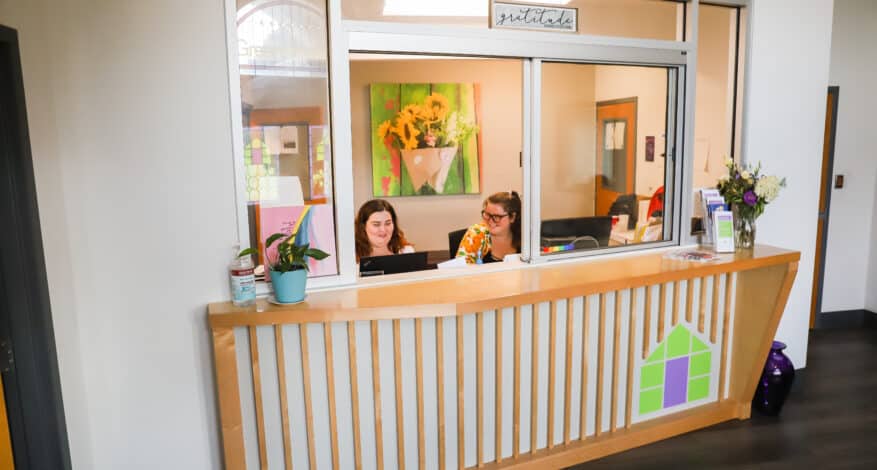
two people at front deskBlog

Shelter Life – Healing Phase

Walking into shelter for the first time can be a very scary experience.

Although every survivor’s journey after fleeing abuse is unique, our shelter services are designed around three phases of shelter life — Welcoming, Healing, and Launching. This is part two of a 3-part blog series that explores common activities during each phase.   

Healing 

“When clients first come in, they work on immediate safety goals – getting all their documents and making sure they have everything they need to basically start a new life,” says advocate Alyssa. 

“When they get to Healing, we work on long-term goals like employment, counseling, housing, legal advocacy, and setting up referrals to the community so they have support systems.” 

Advocate Kristen adds, “And also the emotional aspect of processing what brought you here. After you’re safe and have time to rest, all these feelings and realizations start coming out about your past trauma and we’re here to talk about that and find outlets that work best to regain self-sufficiency.” 

First Meeting 

During the first meeting with their Healing Advocate, survivors discuss their long-term goals during the remainder of their stay at shelter such as finding a job, housing, and transportation.  

Healing Advocates also talk through the survivor’s history and help them process their trauma. 

“We’re listeners and keepers of their stories while we work towards safety for their families,” says Alyssa. 

After the initial meeting, survivors and Healing Advocates meet at least twice a week to work towards their goals. 

Goals 

An important part of the Healing phase is making sure people are connected with support systems in their community like Legal Aid of the Bluegrass and the Children’s Safe Exchange and Visitation program.  

Every survivor’s healing journey is different, but common goals include reaching financial independence, going back to school, working out schedules for their children, and finding a therapist. 

What’s Next? 

When survivors are ready to begin their transition out of shelter, they move on to phase 3 – Launching.

Call us anytime.

24-HOUR HOTLINE 800.544.2022

READ MORE
Blog

Alice, Darling

Alice, Darling is a new film starring Anna Kendrick (Pitch Perfect, A Simple Favor, Trolls) that explores topics of psychological abuse.

The film tells the story of Alice, a young professional in a relationship with a seemingly charming older man. The truths of that relationship are revealed during a vacation with her best friends Sophie (Wunmi Mosaku) and Tess (Kaniehtiio Horn).

With the help of her friends, Alice begins to identify the abuse and eventually ends the relationship. The film premiered to positive reception during the 2022 Toronto Film Festival and was released in theatres this January.

Emotional & Psychological Abuse

Emotional and psychological abuse (also sometimes called mental abuse) can be difficult to identify, especially when the abuser is not physically violent or avoids blatant verbal abuse.

The National Domestic Violence Hotline reports that 95% of contacts reveal they are experiencing emotional abuse: “Emotional abuse is also a foundation for other forms of abuse. Often, it is used to erode a person’s self-esteem and self-worth and create a psychological dependency on the abusive partner.”

Here are a few common examples:

  • Embarrasses you in front of friends and family
  • Mocks you for opinions and beliefs
  • Isolates you from supportive friends and family
  • Belittles your goals or accomplishments
  • Blames you if they cheat
  • Keeps you from sleeping or caring for yourself
  • Tricks or forces you to compromise morals
  • Gaslights you to not trust yourself

“A survivor may find themselves deep into a relationship before realizing that their choices, everything from who they can talk to, see and where they can go, to whether or not they’re able to end the relationship—are no longer their own,” explains this article from Domesticshelters.org.

A Personal Connection

During a recent interview on “Armchair Expert,” a popular podcast co-hosted by Dax Shepard and Monica Padman, Kendrick discussed a past personal relationship that shared similarities with the film.

“We had embryos together, this was my person,” Kendrick says. “And then about six years in – somewhere around there – I remember telling my brother, when things had first kind of gone down, ‘I’m living with a stranger. Like, I don’t know what’s happening.’”

Kendrick describes examples of emotional abuse that escalated when she tried to address her concerns. She remembers feeling embarrassed about what was happening to her.

“There definitely was part of me that was like my mother raised me better than this. How am I the girl during the pandemic locked in my bathroom…facetiming with my two best friends and sobbing and whispering so he doesn’t hear?”

After repeatedly being told by her partner that she was at fault and provoking the violence, Kendrick struggled to identify herself as the victim. She was convinced the problem could be fixed by working on herself.

“I truly dismantled my life,” she says. “I started seeing two therapists a week, and I started trying to learn to meditate, and I got into al-anon.”

Kendrick ended the relationship before starting work on Alice, Darling. She credits a therapist for helping her to establish new boundaries. The actor never intended to speak about the relationship during interviews about the film but instinctively shared her story during a media event.

“It was like I couldn’t swallow the shame anymore.”

Call our 24-Hour Crisis Hotline

If you or someone you know is being abused, our advocates are available every day of the year.

READ MORE
five advocates enhanced protective order planBlog

Enhanced Protective Order Plan

A new program has made it easier for survivors to file petitions for protective orders in Fayette County.

The Enhanced Protective Order Plan (EPOP) is a pilot project informed by the 2020 VAWA Statewide Needs Assessment which examines how Kentucky courts meet the needs of victims and examines barriers preventing survivors and their families from accessing support services. 

Through this program, five of our advocates were deputized to process Petitions for an Emergency Protective Order (EPO) and Interpersonal Protective Orders (IPO) for survivors who already reside at our shelter or receive our advocacy services in Fayette County. 

Fleeing an abuser can be the most dangerous time. This new effort provides survivors with access to the court from a safe location and eliminates transportation barriers that often can delay the process. The support of Certified Domestic Violence Advocates during the process can help ease complications and improve documentation during such a traumatic time. 

The Fayette Circuit Court Clerk’s office will continue to be available for all victims in Lexington-Fayette seeking assistance with domestic violence petitions. These services are available 24 hours a day, seven days a week. Contact the Fayette Circuit Court Clerk at 859-246-2248 for office locations and more information. 

EPOP is coordinated through the Kentucky Courts in partnership with the Office of the Fayette Circuit Court Clerk and the Domestic and Sexual Violence Prevention Council. 

READ MORE
Tiffany in front of flowersBlog

Shelter Life – Welcoming Phase

Walking into shelter for the first time can be a very scary experience.

Our advocates are always here to greet new families, answer crisis calls, and safety plan with survivors ready to flee.

Although every survivor’s journey after fleeing abuse is unique, our shelter services are designed around three phases of shelter life — Welcoming, Healing, and Launching. This will be a 3-part blog series that explores common activities during each phase. 

Welcoming 

“Welcoming is all about loving on you, showing you around, and giving you resources,” says advocate Tiffany.

When a survivor is coming to shelter, Welcoming Advocates get their room prepared and make a welcome bag with toiletries, hair products, washcloths, towels, and comforting items like fuzzy socks.  

When the new resident arrives, a Welcoming Advocate will give them a tour and introduce them to staff members.  

Intake

After they get settled in, it’s time for an official intake. An advocate will talk them through what community living is like at shelter.  

They’ll talk through the groups offered at shelter like Uke Can Do It and farm Make It Take It groups

Documentation & Court

A large part of a Welcoming Advocate’s job is making sure basic needs of survivors and their children are met so healing of physical and emotional wounds can begin. A lot of survivors must flee quickly, leaving everything including their social security card and driver’s license.  

Sometimes a survivor needs help with the emergency protective order (EPO) process and will need to go to court. The Welcoming team can help with this and get them connected with one of our Legal Advocates

What’s Next? 

If a survivor can move out of shelter to their own space, Welcoming Advocates will work to connect them with community resources like storage and moving companies. Sometimes the sheriff’s office will be able to install ring cameras at their new place for safety. 

If a survivor needs more time to get on their feet, they move on to phase 2 – Healing

Call us anytime.

24-HOUR HOTLINE 800.544.2022

READ MORE
Blog

Reflecting on 2022

As the year comes to a close, we are grateful for every day of safety and healing for each strong survivor. ⁣⁣

We’re sharing some of our favorite pictures from 2022 💜

January – Shelter was beautiful and snowy. Even in the worst weather, an advocate is always available to take your call – 800.544.2022
February – The annual Shop & Share event was amazing and we are grateful to every volunteer and shopper!
March – Takiyrah shared her story of survival in the Bloom newsletter.
April – A survivor living in shelter received her keys to transitional housing.
May – Started harvesting vegetables for delicious farm-to-table meals.
June – Enjoyed a small gathering with friends on the farm. A special thanks to Kate Horning and Kellen Macklin for a delicious farm-to-table dinner and mocktails.
July – Enjoyed a field day for survivors and kids. Thank you to Sweet Sisters for cooling down residents and staff with delicious shave ice!
August – Had an empowering time at the first HollerGirl Music Festival which supported survivors.
September – We held a gathering during the autumn equinox to celebrate abundance and acknowledge gratitude.
October – Our Purple Thursday staff photo. Thanks to everyone who participated to raise awareness!
November – A delicious Thanksgiving dinner with farm-to-table pies.
December – The International ‘We Serve’ Foundation planned a holiday party with dinner and gifts for all residents.
READ MORE
josh standing in front of GreenHouse17 signBlog

Running for Survivors

We are so lucky to have a generous community that cares about survivors.  

Josh Nadzam, Co-Founder and Board President of On the Move Art Studio, shares his personal connection with intimate partner abuse and how he uses his love of running to support survivors. 

Thank you, Josh!  

The first phone call I ever made was at 5 years old. I called 911 because my father was choking my mother up against a wall. Making a plea to the dispatcher was the most I could do then, but once I became an adult I was determined to do much more.

One way I could do this was by leveraging my ability to run to raise awareness for eradicating domestic violence and raise some funds for survivors along the way. After five years on the Track and Field and Cross Country Team at the University of Kentucky, I had quite a bit of training that prepared me to do just that.

My first attempt at this was in 2014 when I ran from Lexington to Frankfort (25.5 miles) for HB 8, a bill being considered to protect dating violence survivors in Kentucky. On March 6, 2014, “Josh’s Run to Frankfort” took place, running from the Fifth Third Pavilion to the steps of the capitol, raising nearly $5,000 along the way.

The second and third times I leveraged this ability was when I qualified for the Boston Marathon. I decided to dedicate each race to survivors of domestic violence, and created a campaign called Bluegrass to Boston for Survivors. In 2016 and in 2019 I asked friends and family to support me by making donations that would go to GreenHouse17, with the former raising $3,000 and the latter raising $2,215. Each time it was so incredible and moving to see so many people passionate about supporting survivors.   

Each one of us has at least one unique skill we can use to benefit others and help make the world a better place. Some of us can sing or draw, dance, play music, photograph the world, cook, or knit. I’m fortunate to be able to run and have been able to use that ability to try to rally support for survivors. I’m endlessly grateful that GreenHouse17 does the incredible work they do so that one day, no 5-year-old child will ever have to call 911 again to stop one parent from abusing the other. And because of GreenHouse17, I am certain we can accomplish this. 

image
image
image
image

*Images in front of the GreenHouse17 sign were taken by Ayna Lorenzo of Mothwing Photography

Click here to read more.

Learn more about On the Move Art Studio!

READ MORE
strawberry harvest from farmBlog

Autumn Farm Reflections

This is a special blog contribution written by Hattie Nunley, farm advocate.

As the days grow shorter and an autumn chill hangs in the air, now is the perfect time to reflect on this past season of beautiful blooms and fresh produce grown on our farm.

Advocate and survivor hands were busy working in the soil this season as we tended to the many flowers, fruits, and vegetables growing on the farm as part of our Summer Flower CSA and farm-to-table dining.

January began with farm advocates sowing thousands of flower seeds in our indoor growing space before eventually moving them to our greenhouses. In March, we began transplanting cold-loving flowers into our high tunnels and eventually transitioned into the field once the danger of frost had passed.

June rolled around soon enough, and our Summer Flower CSA was in full swing! The CSA saw success once again this year, marking the 10th year of our bountiful bouquets. The 130 members who supported our program enjoyed a variety of vibrant cut flowers, including sunflowers, zinnias, lisianthus, snapdragons, celosia, cosmos, eucalyptus and so much more. All in all, we estimate that over 41,500 stems were harvested and sold from the beginning of June through the end of September!

To celebrate the conclusion of another year of our CSA, we hosted a U-Pick event for the first time since 2019. This was a special occasion where we welcomed 50 community members onto our farm to explore the space and pick flowers grown by survivors.

image
image
image
Farm Programming

Of course, we could not have done any of this without the help of the 16 survivors who participated in our nature-based healing program this year. Also called our Farm Stipend Program, this opportunity connects survivors with the Earth and allows them to process their experiences in a uniquely therapeutic way while also earning money and job-skills training. Participants are involved in every aspect of flower production from seeding to harvest, and we are proud to these are homegrown by survivors.

Survivors not in the stipend program were encouraged to take part in the dozens of farm-related support groups offered this year, with over 330 residents participating in activities such as wreath making, resin art with dried flowers, paper making with pressed flowers, strawberry jam canning, pickle canning, and much more.

Expanding on last year’s goal of providing farm-to-table produce to our shelter residents, over 3,000 pounds of fresh produce were grown this year to fuel our farm-table dining program. Some of the favorite vegetables harvested and used in shelter meals included heirloom tomatoes, yellow squash, zucchini, cucumbers, onions, garlic, potatoes, sweet potatoes, kale, broccoli, and butternut squash.

Our shelter advocate with focus on food and nutrition has been working hard to ensure that we incorporate farm-fresh ingredients grown on the farm in the delicious meals she prepares to spark conversation around nutrition and mindful eating.

We are grateful that our farm programming has continued to nurture the lives of survivors during their time in shelter and raised awareness of our mission throughout the communities we serve. Until next year!

Nature Heals

Follow the link above to read more articles from the farm.

READ MORE
Blog

Handmade Experiences

“I know whoever purchases our products will enjoy them as much as I’m liking being a part of making them.”

These words were written by a survivor who participated in handmade programming on the farm that surrounds our emergency shelter. The process of making products encourages healing and economic opportunity in a safe and caring environment.

“It was a lifeline,” shares Jewell. She received a weekly stipend while working to develop, make, package, and label handmade products. “This program gave me some kind of purpose, or drive, or reason to get up. There were a lot of days that I contemplated not coming and realized this is where I needed to be.”

Another survivor who prefers to remain anoymous shares how the process is helping her: “I’m making new friends and getting outside of my comfort zone—and really starting to enjoy myself again.”

Your purchase of Handmade by Survivors products makes these stories possible. Every product we make is natural, nourishing, and creates hope for brighter tomorrows.

“I feel peaceful and my mind feels clear,” shares LaTonya, who helped develop, test, and make the Benevolence variety of cold-process soap. She describes the experience as very therapeutic.

“Whatever the task may be, I feel empowered to take on that task, and that is so uplifting for me.”

Shop Handmade by Survivors

Follow the link above to shop now.

READ MORE
members in front of grace churchBlog

Safety to Flourish

Planning has begun to expand the Children’s Safe Exchange and Visitation program to Boyle County next year. 

Members of Grace Church have generously agreed to provide space for the services in the children’s wing of their facility in Danville.  

“As a church, we are committed to helping the families and children of our community flourish,” says Assistant Pastor Kevin. “We are excited about the opportunity to open some of our space to help meet this need.” 

The program currently operates in Fayette and Scott counties. Services honor the importance of the parent-child relationship and strengthen this bond without the worry of conflict, intimidation, control, and abuse.  

“No one issue or need in our community will be met by a single organization,” Kevin explains. “It takes many people and organizations playing a small part, and we are excited to play ours.” 

Additional funding from the Hudson-Ellis Fund at Blue Grass Community Foundation will support program start-up costs.

Read the Fall 2022 Issue of Bloom 💜

This is one article from our print newsletter. Follow the link above to read the full issue!

READ MORE
Blog

Colorful Expressions

 
“There’s something very healing about making something with your hands.” 

Making art can help survivors of intimate partner abuse find their own path to healing. That’s why advocate Kristen hosts a weekly art group.  

Like the nature-based healing approach of our farm, artmaking improves feelings of well-being and self-worth. Making art with other survivors encourages connection, reducing the frequent feelings of isolation some survivors experience.  

“It’s so awesome to see survivors change their perception of the world through art,” says Kristen.  

Kristen has introduced more artmaking experiences this year thanks to the Art Meets Activism grant through the Kentucky Foundation for Women.  

The generous grant supported training for her to become a certified facilitator of trauma-informed art workshops, while also providing funds for materials, equipment, and offsite artmaking experiences for survivors.  

“We’re exploring different mediums and ways to express trauma, emotions, and using it as a tool to rediscover oneself,” she shares.

Read the Fall 2022 Issue of Bloom 💜

This is one article from our print newsletter. Follow the link above to read the full issue!

READ MORE